Showing posts with label Bookshelf. Show all posts

Friday, February 1, 2013

My review of Peace, They Say in Touchstone

As I mentioned when I reviewed Jay Nordlinger's fine book Peace, They Say here on Montana Headlines, that review was essentially half of the original draft of my review. I pared that draft down for submission to Touchstone magazine, and used the cuttings in the above-mentioned Montana Headlines review.

I have written a number of times over the years for Touchstone, a fine serious magazine that deals with the nexus between Christianity and culture from a traditional perspective. It includes a balance of Roman Catholic, Eastern Orthodox, and Protestant writers and editors, and for those who are interested in both Christianity and modern culture, its pages contain some thoughtful gems.

As a side-note, it is a little scary to realize that it has now been more than 20 years since my first piece appeared in its pages.

Anyway, my review was just published, and here is the link -- enjoy!

Friday, August 31, 2012

From the bookshelf: Winter in the Blood by James Welch


Well, I'm back -- maybe a little fuzzy-headed still (some might argue that I'm always fuzzy-headed, of course), but ready and eager to get back to my regular Montana Headlines publication schedule. I've not been idle when it comes to writing, and as things get published, I'll of course provide notices and links. But I've also had the chance to get caught up on a little reading.

Winter in the Blood was Montana author James Welch’s first novel. It originally came out almost 40 years ago, and has tended to live under the shadow of Welch’s later and more famous books like Fools Crow and Killing Custer. Before returning to the book, though, how about a classic Montana Headlines digression?

One of the privileges I give myself as publisher, editor, staff writer, publicist, webmaster, chief cook, and bottle washer of Montana Headlines is to do reviews of books that aren’t recent releases – or that aren’t necessarily even in print. I’ve always wondered: why wouldn’t publications want to do some reflective reviews about outstanding books that have been out for a while rather than only doing immediate reviews of recently published books – some of which might be mediocre? Maybe the publication has even already reviewed the book – how about a retrospective review by a second reviewer some years down the line?

I remember as a young and enthusiastic writer, I once wrote a long review essay on the western ranching experience. The three books that I built my essay around, as I recall, were Marc Reisner’s Cadillac Desert (a magnificent book on the whole topic of water in the West), Sharman Russell’s Kill the Cowboy, and another book about ranching in the San Luis Valley of southern Colorado, the name of which now escapes me.

I was pretty happy with how it had turned out, so I wasn’t completely surprised when I soon got a phone call from the book editor of the magazine I’d sent it to, and for whom I’d done some other reviews. Back in those days before email, it wasn’t unusual to have an editor call you up to say he wanted to use your piece and to handle some straight-forward editing on the spot over the phone. The first question from him this time, after saying he liked it, was “what were the dates of publication on those three books?” I had the books ready to hand, and told him. All were recent, as in within the last few years, but none were true “recent releases.” Bottom line was that he loved the essay and it was perfect for his magazine, but it just wouldn’t work because they only reviewed recently released trade books.

I was obviously disappointed, but after that I learned to play by the unforgiving rules of the book review game. (I wish I could still find a copy of that manuscript today – I happen to know the editor of this site called Montana Headlines, and I think he’d publish it.) One understands why it is the way it is – a magazine doesn’t want to be thought to be behind the times compared to its peers and competitors that reviewed it a year or more ago, and the book publishers are interested in promoting their most recent releases, since the most profitable thing in book sales are newly released hardbacks.

Still, the whole process is a bit of a shame, I’ve always thought. I don’t know about anyone else, but unless I’m doing a paid review for publication, I rarely buy and read a book immediately when it first comes out in hardback. As I’ve mentioned before here on MH, books tend to sit and marinate on my shelves for a time, ripening like fine wines until it seems like just the right time to read them.

Well, enough of the digression, and on to Winter in the Blood. I was put on to this book by my friend Ed Kemmick. (At the risk of ruining Ed’s reputation, I have to thank him for his moral support over the years that I’ve been writing Montana Headlines – I’ve been saved many a time from posting some seriously nasty sarcasm in the heat of a political fray by the question "WWET?" niggling in the back of my mind. (That’s “What Would Ed Think?)

Ed knows as much about Montana literature as anyone I know, and when he announced that he was placing Winter in the Blood in his Montana literary pantheon alongside A.B. Guthrie's The Big Sky, I knew I would need to read it sooner rather than later.

In short: it has been some time since I have read anything as remarkable as Winter in the Blood – the fact that it was Welch’s first novel only makes the achievement more impressive. At first glace, it seems that what Welch did was to give us a gritty and unsentimental piece of realist literature set on and around the Blackfoot Indian Reservation. In the first paragraph, the protagonist is taking a leak in the weeds near an abandoned cabin with a fallen-in roof while “tumbleweeds, stark as bone, rocked in a hot wind against the west wall.” The reader can’t claim not to be warned that he is in for a long, dusty, and depressing ride. And yet before the first short chapter is done, Welch lets us know that he will be taking us a bit deeper:

…the distance I felt came not from country or people, it came from within me. I was as distant from myself as a hawk from the moon. And that was why I had no particular feelings toward my mother and grandmother. Or the girl who had come to live with me.

We don’t meet that girl for the longest time – she is already gone, headed to town with the young man’s .30-.30 rifle and his electric razor – things she could sell for a quick buck. While it is never spelled out what the money was going to be spent on, there is never really much mystery. Most of the book seems to peer through an ever-present alcoholic haze.

There is much to commend a young man who would portray unflinchingly the ravages that the white man’s firewater has wreaked on Indian Country, but Welch transcends the stereotype with an existential depressing fog that is so unrelenting that one begins to see the perpetually drunk state of the characters not as gritty realism, but as a metaphorical portrayal of the Native American state – never completely at home, never in their own reality, always vulnerable and potential victims for those who aren't in that altered state.

Yet whenever Welch briefly lifts the fog – most notably in flashback chapters in which the protagonist is spending a day with his beloved brother and father, working on their ranch – one sees piercing glimpses of what things could and should have been like for Native Americans, even when having to accommodate life with the white man.

There is no whining in Winter in the Blood, no playing the victim. Even the rare clear statement of what the looming presence of the white man means to the protagonist is laced with a cool detachment. I’m not sure I’ve ever encountered such a brilliant, subtle, and multi-layered portrayal of the destruction let loose on our Indian populations -- and of the complicity (willing and helpless) of Indians themselves in their own cultural losses. There are no cliché’s – no tantrums.

The place where Welch had gripped me emotionally -- and where it was clear I wouldn't be released from that grip until I had finished the book -- was in a flashback scene where he and his brother are sitting eating the breakfast their father had fixed them before a hard day’s work rounding up cows. Out of nowhere, in the middle of a matter-of-fact description of the morning, came the simple, powerful sentence: “He loved us.”

I realized that I had read most of the book by this point and had yet to encounter love of any kind in the protagonist’s life -- only alcohol and emptiness and betrayal and exploitative relationships that would make anyone cynical.

And yet, in that instant, the reader knows that the protagonist knew exactly what love was, had experienced it, and had lost it. Far from being in an alcoholic fog of disorientation, the protagonist’s pain suddenly becomes excruciating for us precisely because we know that he knows... He has memories of real love, and isn't about to stumble toward any fake substitute.

The trips to Havre and Malta, on the surface, seem like just more dusty, sweaty realism. But as archetypes loom, unbidden, by Welch’s spare and precise prose, it feels more like a journey to hell and back (as the place where Indians from the country would more often than not end up drunk, perhaps beaten up and robbed, it really is pretty apt metaphor for journeying to hell.) At times, as he searched for the girl who had briefly come to live with him and then robbed him and headed back to town, I wondered if Welch was consciously tapping into the myth of Orpheus journeying to the underworld to try to bring back Euridyce, his love.

Probably not, but Winter in the Blood is that kind of book – one where you know that even though you’re reading the text and discerning subtext, there are yet more layers, simmering beneath the surface, perhaps readying for a volcanic explosion. One where you are certain you encountered this story before – maybe in Greek mythology, maybe in Shakespeare… -- something by a master of portraying universals of the human condition. Or maybe not -- maybe you're just reading James Welch for the first time.

Read the book. See if you agree that it belongs in your Montana literary pantheon – it is certainly in mine, and it won’t be the last James Welch book I read and talk about here on Montana Headlines.


Friday, August 3, 2012

From the bookshelf: Peace, They Say -- by Jay Nordlinger


Update: Here is a link to my main review of this book in the journal Touchstone, that was published later (Jan 2013).

* * * * *

With more than a century’s worth of laureates to choose from, Jay Nordlinger (a senior editor at National Review and music critic for The New Criterion) has said that some well-meaning friends advised him to write only about the interesting ones in Peace, They Say, his history of the Nobel Peace Prize. The trouble with that approach, he says, is that the laureates are all interesting – one doesn’t win “the most famous and controversial prize in the world” by having lived a boring life.

Besides an author’s understandable desire for completeness, however, one suspects that another reason for including at least a short account of every laureate from the founding of the Nobel Peace Prize at the dawn of the last century through the crowning farce of President Obama’s selection in 2009 (he was nominated shortly after taking office) was to put the achievement of this award into a certain mildly skeptical context, since the more deserving laureates stand out clearly from the crowd.

Nordlinger groups decades worth of Nobel Prize winners into chapters he calls “parades” (echoing the Oslo torchlight parade that is held in honor of the winning laureate,) interspersing these chapters with fascinating background material such as the actual nuts and bolts of the selection process, a biography of Alfred Nobel himself, reflections on why certain seemingly obvious candidates weren’t selected, and disquisitions on the meaning of the word “peace.” While all of the winners are indeed interesting, all too many prize winners are interesting in almost everything except for the real reasons they won the prize.

The most memorable highlights of the book are when a personality periodically breaks through the mind-numbing strings of organizers, activists, relief workers, and professional moralizers, arresting our attention with sheer (dare one say it?) manliness. One is Fridtjof Nansen, a Norwegian who won in 1922. He was a “scientist, explorer, athlete, professor, diplomat, executive, humanitarian,” and Nordlinger describes him as being a more accomplished Indiana Jones, with the additional quality of actually being real. He broke a world speed-skating record, charted the Arctic, was Norway’s first ambassador to Great Britain, curated the Bergen Museum, and engaged in a series of humanitarian missions around the globe at the request of the League of Nations, beginning with taking charge of repatriating hundreds of thousands of prisoners of war to their native lands after the Great War of 1914-1917.

Another is Ralph Bunche, a Detroit native who was a high school sports star and valedictorian, going on to UCLA on a basketball scholarship, where he was again a sports star and valedictorian. Then, on to Harvard and two graduate degrees -- all of this achieved by a black man living c. 1920 in a pre-affirmative action America. Bunche’s politics tended toward the radical in his early days, according to Nordlinger, but unlike so many radicals of his time, he had the awareness to recognize when organizations were controlled by the Communist Party and the good sense to avoid them. After serving in the American intelligence services during WWII, he went on to work for the State Department and then the U.N., where he found himself as the chief mediator between the newly-formed state of Israel and several neighboring Arab states. As with all such efforts in the Middle East, the resulting peace was short-lived, but Bunche stands out for the remarkableness of his personal story, irrespective of his personal politics or the transience of the achievements for which he received the Nobel.

Early winners of the Nobel Peace Prize tended to be idealistic sorts with great fondness for committees, associations, treaties, conferences, and arbitration. Their naïveté is almost touching, knowing what we do about the coming bloodbath that was the Great War, an event that flicked members of the peace movement away like so many fleas.

It is a bit embarrassing, really, to see the silly utopianism of American Secretary of State Frank Kellogg (the 1928 winner) who “outlawed war” with the Kellogg-Briand Pact– a document that in its bearing on reality resembles a court injunction to shut down the earth’s gravitational field. Such laureates were, however, acting at least in part in the spirit of Alfred Nobel, the founder of the prizes that still bear his name today, and who viewed war as the “horror of horrors.”

Nordlinger’s account of Nobel’s life is one of the most intriguing stories in the book, painting a much more complex portrait of the man than the commonly encountered one – namely, that he was a man who felt so guilty about inventing (and spending a lifetime manufacturing and selling) the dynamite that was used in arms-making that he established these prizes to relieve his sense of guilt. While this story fits modern liberal sensibilities and guilt-complexes, it isn’t true.

Nobel as Nordlinger portrays him is a man such as our own age seems unlikely to produce: a polymath and polyglot, deeply read in literature, an amateur but dedicated writer and translator – and all the while, a brilliant scientific inventor and entrepreneur and a hugely successful industrialist unashamed of his accomplishments and of the wealth he accumulated.

While Nordlinger conveys that Nobel’s political views were complex and sometimes contradictory, of interest is his observation that Nobel was “skeptical of democracy, and of the mob,” sentiments that would be abhorrent to those who control the Peace Prize today. Also contrary to the views of many of laureates, Nobel believed that demanding disarmament was “really only to make oneself ridiculous without doing anyone any good.” On one point, Nobel showed a certain prescience: he believed that once weapons became powerful and terrible enough, nations would be forced, out of self interest, to stop going to war. Nordlinger terms this a point of “innocence” on Nobel’s part, but in a sense Nobel was right. Once large stores of nuclear weapons were accumulated, direct war between great powers became a thing of the past. Traditional wars with guns and bullets largely took place on the periphery of the Cold War, and even afterwards wars between nuclear powers have been avoided.

The Prize has evolved into something highly political, and few things show this more clearly than the fact that the last three Democratic administrations contain Nobel laureates (Presidents Obama and Carter, and Vice President Gore.) The last award to someone in a Republican administration (given to Henry Kissinger in 1973 for his work in peace talks with North Vietnam) is, according to Nordlinger, the most unpopular in the history of the Peace Prize.

Perhaps an even greater source of irony is the fact that President George W. Bush, regardless of how history will view his tenure in office, managed to achieve a certain level of immortality in the world of the Nobel Peace Prize by being responsible, in whole or in part, for no fewer than 6 awards. The committee despised him so much that they seem to have been unable to resist giving awards that would be seen as a slap in Bush’s face.

The series of “anti-Bush” awards started with a sort of pre-emptive “warning” award after 9/11, with the run being interrupted only long enough to give the prize to a tree-planter in Kenya (2006) and a Third World “microloan” specialist (2008) -- awards that serve almost as comic relief from the otherwise tedious obsession with Bush during that decade. The awards to former VP Gore (2007) and to the newly-elected President Obama (2009) brought the art to new heights, combining anti-Bush animosity with specious grounds for being given the award (Mr. Gore for his global warming activism and Mr. Obama for not being Mr. Bush.)

Even someone skeptical about the value of the Nobel Peace Prize has to admit that the history of this award is fascinating, especially when presented in the way that Nordlinger does. He highlights obscure laureates who have been unjustly forgotten, and he shares anecdotes about even the best-known selections. In one instance, we learn that Lech Walesa may have owed his award to a handful of Polish protesters at the previous year’s ceremonies, accusing the Nobel Committee of being afraid of challenging the Soviets on anything. In another, he notes that the same committee that gave the award to Begin and Sadat wanted to include President Carter, who had helped broker the talks – but couldn’t, because no-one anywhere on the globe had nominated him.

Nordlinger’s predictions for where the Nobel Peace Prize will go from here tend toward more of the same, including new fashionable causes that will stretch even further what “peace” is, as defined by the committee. Even though skepticism is a subtext of the book, he unfailingly treats both Prize and laureates with the respect and decorum that is a trademark of Nordlinger’s writings. He has to be one of the few writers who could induce this reader to read and thoroughly enjoy a history of the Peace Prize.

* * * * *

Note: There is a lot to say about this fine book. My main review (equally laudatory) of this book will be appearing in an upcoming issue of Touchstone magazine. I'll provide details when it appears -- a link if available, or a reprint on this website 90 days after it appears, as per that magazine's guidelines.


Friday, July 13, 2012

From the bookshelf: Words Made Fresh: Essays on Literature and Culture, by Larry Woiwode


Something I neglected to mention when I reviewed a Larry Woiwode memoir last week is that the most recent of his many literary awards was presented to him in Billings last year, when he received the Emeritus Award at the High Plains Book Awards ceremonies. This week I want to mention his most recent book, Words Made Fresh: Essays on Literature and Culture. This slim but dense volume is a first for Woiwode -- a collection of formal essays on literature and writing. An alternative subtitle might have been borrowed from Hank Williams, Jr., however: “A Country Boy Can Survive,” as will be clear from what follows.

This book is a welcome addition to the library of anyone who enjoys Woiwode’s works and reflects an aspect of Woiwode’s life that hasn’t been accessible to most readers -- namely, Woiwode the teacher and critic. Like many serious novelists, Woiwode has, whether through choice or necessity or both, done repeated stints as a teacher: at the university level, as a lecturer at conferences, and as an essayist.

As mentioned in the review of A Step From Death, Woiwode has written thoughtfully in his memoirs about his approach to writing, but he has always touched on the subject indirectly in the course of talking about his life. In Words Made Fresh, Woiwode the essayist expounds directly and without a veil -- on writing, writers, literary criticism, and education.

The first essay is the oldest -- a piece on guns written for Esquire in the mid 1970s. It is a period piece in that it reflects a certain depressing, even pungent, 1970s ambience. It is also a personal period piece, since it comes from a particular time in Woiwode’s life that seems a bit foreign to those who got to know him later on. In quality, it is certainly worthy of the writer of What I’m Going to Do, I Think (a book in which a gun features prominently) and it has been previously collected in a number of anthologies. Still, as one cautiously steps through its sometimes heavy existential fogs, one can’t help but think that Woiwode may have chosen to lead off his book with this particular essay partly as a way of showing the reader, “So, here is where I started. Perhaps you can now better appreciate the much better place I am about to take you next.” As a side note, it is hard today, when the 2nd Amendment battles have largely been settled (for now) in both political parties, to realize what a shocking piece this would have been in the era of Jimmy Carter: a respectable cutting-edge writer living in New York City and confessing to a lifetime fascination with firearms.

The country boy theme continues with Woiwode’s essay on the farmer/poet/essayist Wendell Berry, who has long been a favorite at Montana Headlines. It is is a sheer delight. While each has been making his way in quite different topography (Wendell Berry farming in the hills of Kentucky, Woiwode on the high plains of western North Dakota), both inhabit the same world. They are, in a sense, moral and cultural neighbors. Berry’s prose is the very picture of clarity and economy, and yet Woiwode is able to boil down his insights even further into sentences that convey the essence of Berry's work while also suggesting the vistas that await the reader. Woiwode wisely concentrates on Berry’s essays, since these are the place to start if one wants to grasp the richness of this writer who is, first and foremost, busy with living on his land with a woman who loves him, working to turn a financial profit from his family acreage using organic, even preindustrial techniques.

Berry's writing, rather than a source of profit to support a farming hobby, feels like the abundant fruit of that life. Reading a Berry essay (or even more acutely, a Berry poem), feels like being at a community gathering where songs are sung, stories are told, and photos are passed around. The day’s work has been done, and it is time to light the fires, tune the instruments, gather around the person telling the history of the place, and let the magic begin on a winter’s night.

Woiwode captures the essence of Berry a number of times in this essay but never better than this:

Certain passages and paragraphs have the power to lift you into stretches of contemplation and personal reassessment – those periods when you seem to be staring out a window but are really assessing the realignment your consciousness is taking on. Berry’s books are that well built and keep revealing new dimensions.

Indeed. Continuing on with another country boy, Woiwode devotes two essays to the criticism and fiction of John Gardner. I first encountered Gardner many years ago when I bought a well-worn copy of his magesterial On Moral Fiction, after which I was never able to read a novel the same way again (and happily so.) Woiwode’s respect for Gardner’s powerful and provocative criticism is clear, and it is well-deserved, since there is really no-one quite like him. Of course, Gardner’s rural background doesn’t hurt:

Gardner was a farm boy, unabashedly so, and usually lived in a rural setting with his family and a menagerie of animals. [ ] As a critic, Gardner kept his square, strong farmer’s hand firmly on the pulse of American fiction, and you either waited for or feared his reviews and assessments of writers and writing – his manifestos, as they were seen by some, diatribes and hallucinations by others.

In Woiwode’s lengthy multi-part essay on John Updike (also greatly admired by Woiwode), things might get a bit involved for someone not familiar with the full sweep of Updike’s oeuvre (I am not), especially when he discusses religious matters and the relationship between Updike’s devout Christianity and his writing. Nevertheless, one finishes the essay motivated to buy and read a pile of Updike’s novels.

Elsewhere, essays touch on subjects as diverse as Bob Dylan, Shakespeare, and education. Again the country boy theme continues in various forms: Dylan in obvious ways, education in talking about his experiences with home-schooled children (including his own), and Shakespeare in the freshest ways possible:

Lore and court records have him returning home at least once a year, and it’s likely he went back to check on the lamb crop each spring (along with perhaps cattle, maybe swine) and to oversee the seeding of his barley and wheat, and he would want to be present in late summer or early fall for harvest.

He seems to have known from the start that Stratford (farming populace and handcraft merchants) was the source of its accomplishments, and he paid it homage, dying in New House only blocks from where he was born, leaving a healthy largesse to Stratford’s poor. Only a person who was nurtured by and nurtured the earth over its diurnal and seasonal changes could have written his plays -- rural boy that he was, farmer or farming-inclined son of a rural tradesman and farmer.

Woiwode is an unapologetic Christian, although he doesn’t wear it on his sleeve. He isn’t a “Christian writer,” but rather a writer who decades ago turned to a life of Christian faith. There is a difference -- a difference that Woiwode saw in Updike as well. To Woiwode, there is no place for a pulpit in a novel, whether that pulpit is Christian or atheistic. What matters is being faithful and honest in one’s work -- the rest will take care of itself. As he notes in the opening essay:

It’s life here we’re responsible for, in its minutest detail. We should expect to give an account, according to a teaching of Jesus, for every idle word that comes out of our mouths. That’s a weighty responsibility for a writer.

Friday, June 29, 2012

From the bookshelf: A Step From Death by Larry Woiwode


It's Friday, and time for a book review.

I am overdue on paying tribute to some of the great writers who live in this region, and given some of my Monday preoccupations, it is perhaps appropriate that I choose first a writer who was born and raised in North Dakota, and who returned to live in the western high plains of that state after having made his name in the New York literary world. I speak, of course, of Larry Woiwode.

I first came across Woiwode's name in a dusty pile of magazines in a little room where I was doing some tedious research work to make spare cash while a starving student. Always looking for something to read, during a break I picked up a cultural magazine I hadn't heard of before and read an article in which Woiwode was briefly mentioned. Something about the reference intrigued me, and I ordered up a couple of his books on interlibrary loan at the local public library (does anybody even do that anymore? I ordered them by the pile back then, since I couldn't afford even to buy many used books and since the stores available to me so often didn’t have the books I was looking for.)

In any event, I took one look at the thickness of his masterpiece, Beyond the Bedroom Wall, and decided that I needed to save it for a bit later. I saw in a biographical note that he had settled on a small farm/ranch near Mott, ND and thought this a bit odd, even though the southwestern corner is that state’s most habitable part. Didn’t big writers settle in places like Aspen or Livingston if they chose to come west? I figured it was one of those whimsical things that some artistes tend to do and that it wouldn’t last. The joke was on me – by the time I read that bit about Woiwode, he had already been back in North Dakota for nearly a decade, and he has now been living and writing there for 35 years.

The first thing of his that I read was his brilliant first novel What I’m Going to Do, I Think, which I read in a single sitting. His defining work, however, is still his second novel, Beyond the Bedroom Wall, for which the often overused phrases of “achingly beautiful” and “heart-rending” really do apply... and then some. I actually had to stop reading when I saw its painful denouement looming on the horizon and was only able to return to finish the book years later.

While fiction remains at the center of Woiwode’s identity as a writer, he has in recent years turned to a series of memoirs that have been every bit as captivating as his novels. He started with Acts, which, while ostensibly a reflection on the Biblical book of the same name, was interwoven with personal reflections – spiritual and literary – that seemed to be an initial exploration of the genre. Then, there was the wonderful What I Think I Did: A Season of Survival in Two Acts, in which Woiwode recounts life on his farm during the historically harsh 1997 winter, using it as the structure around which he delves deeper into personal musings on his life and writing.

His most recent memoir, A Step From Death, had been sitting on my shelves for a few years, marinating, as do so many books, until just the right time to read it arrived, which it recently did. This memoir uses as its taking-off point Woiwode’s encounter with the power take-off (PTO) of a baler he was running (guess which one came out more unscathed) and is written in the voice of Woiwode talking to his son.

Woiwode’s writings are haunted by memories and dreams, sometimes jumbled together in a seeming disorder that masks the granite structure that holds them together, and A Step From Death is no exception. As with his earlier memoirs, Woiwode writes as if caught in a great spiral, coming round again and again to the same people and themes, but each time touching down a little closer to the center of what it is he wants us to understand. He writes, for instance, of his relationship with his long-time editor at the New Yorker, William Maxwell, who was friend and mentor to a young Woiwode making his way in New York. We learn much about Maxwell in What I Think I Did and even more in this memoir, now discovering that part of Maxwell’s instinctive affinity for Woiwode was the fact that both had lost their mothers at the same young age. Being haunted by similar ghosts and having had to navigate without the North Star that is one’s mother, Maxwell was perhaps uniquely able to guide Woiwode as he found his voice and his story.

Woiwode’s long string of New Yorker stories and his two most important novels -- Beyond the Bedroom Wall and Born Brothers -- tell the story of multiple generations of the fictional Neumiller family, which is rooted in Woiwode’s own memories. A Step From Death now introduces us more closely to some of the people who inspired his fiction. Particularly moving to me was his recounting of a visit to the remote Minnesota farm where his maternal grandparents lived:

Water for drinking and cooking and bathing and poultry and livestock – a dozen cows and a team of horses Grandpa uses to cultivate the acreage he breaks after clearing the jack pine – every glass or bucket of water is pumped by hand at a hand pump from a hand-dug well. The primitive nature of the place enhances my affection for it, in my quest to resurrect the primal scene, although it isn’t until I’m out of college that I realize I grew up in an earlier century and carry a heritage nobody younger can know, no American will, not anymore, and here I first sense words embedded as deep as muscles go, along with their roots in an earlier language, an intuition of this trembling in me as my grandmother reaches out and puts her hand over my head.

How does she know to do this?

The history of a family begins with a woman, to condense Cather, and the pressure of her hand produces generations behind her, as if I’m a boy they recognize from a dream, mingling with us in a room smelling of lefse, that Norwegian potato tortilla she rolls thin as a thumbnail, the scent of fresh bread a bass note, and then in a crush of air she hurries to the piano and she and my mother sing hymns in the house whose only locus is the Minnesota woods.

Woiwode’s observations are particularly poignant for me, since I have also come to the realization that the world in which I grew up – the one-room country school, the preternatural silence that only remoteness can give, the smell of tilled soil and ripened hay, the sound of the wind and the feel of a stirrup against one’s boot, the gatherings where the old songs were still sung – while once a common American experience, this is now one that few people one encounters know anything about, and the ones who do know tend to be decades closer to death than oneself, yielding the prospect of a dotage in which many of one’s memories will be unshared.

About that silence, though. How about another passage from the book?

Late one night (after first moving back to North Dakota), realizing I could follow every car and truck on the highway five miles off, my hearing reached so far I felt a backwash as my ears twitched and throbbed to open wide. I couldn’t sleep for the silence. Out the bedroom window our tree rows looked frozen under a fall moon. Farther off, two miles if I could fly true as a crow, the pole light of a neighbor glowed, and in the wind rocked and sparkled like a distant star. A dove sounded its mourning notes, ah ooo --- hoo-hoo-hoooo, and then a pack of coyotes started up their operatic prelude, yodeling from a distant hill, their chorus answered by barks and yips from far fields, and with the natural world carrying on its concourse I slipped into sleep as if listening to Mozart.

Woven through the book are literary reminiscences that will delight anyone who loves writing (whether reading it or indulging the vice personally.) We catch glimpses of Woiwode agonizing during his long nights (when at his most productive, he tended to work through the night, going to sleep when the rest of the household was rising) over getting his prose just right, and having read his novels, we believe it. And there are insights into what he aims for:

My work attunes me to the versatility of words. I like language that’s allusive but solid enough to allow comic somersaults within its gravity, while meaning radiates from its premises to wider realms.

For a Montana reader, of interest is a young Jim Harrison, accompanied by an equally young and larger than life Tom McGuane, appearing at the doorstep of a cabin in the Michigan woods where an even younger Woiwode was living with his wife and daughter, trying desperately to keep writing through the emotional overwash that came after the publication of his first novel. In McGuane’s “My galleys came a while back. Isn’t it great to be a real writer!” one already gets a glimpse of a man enthusiastic about a certain kind of literary life, one who would later have to deal with accusations (perhaps from the jealous) that he was better at being a Hemingway-like literary celebrity than at writing.

Ultimately, however, A Step From Death revolves around the things most important to Woiwode – his faith and his family – their priority proven by repeated decisions to choose both over his writing career when those forks in the road appeared before him. Not content with recounting just the one brush with death-dealing farm equipment, he weaves into the memoir a family’s lifetime of experiences with nearly losing life and limb (we all have more than we like to remember – and the more rural one’s existence, the more we have.) Each reveals a little more about the preciousness of this short time that we do have with the ones we love, and each brings us, if we are willing, to contemplate the death that we will all eventually face one final time.

And this, Woiwode explains, is a part of why we are so often drawn to memories – both our own and those of others. Writing in the book to his son, he says:

...every forward inclination, even a life-enhancing one, is another step toward death. And if you feel I keep stepping further from the present, yes, I do. The past is my secure sector of existence – everything I’ve been through, no matter how trying it may have been, is over. It’s death that lies ahead…

Morbid? Actually not. Using another overworked phrase, it would be hard to imagine more “life-affirming” writing than Woiwode’s, including this book. For those who have journeyed with Woiwode over the years, A Step From Death allows us to walk with him for a time as with an old friend. And for those who haven’t, it is an accessible book that displays the range of his talents as a writer and that will likely leave those readers wanting more.

Friday, May 25, 2012

From the bookshelf: The Twilight of the Intellectuals by Hilton Kramer

It’s the weekend -- time for a book review.

With the dismantling of the Berlin Wall in 1989 and the formal dissolution of the Soviet Union in 1991, the world as Americans had known it suddenly changed. America had won the Cold War on its European front from a military and political perspective (largely forgotten at the time was Chinese communism, which had played such a looming role in our two major military conflicts of the Cold War era,) but in some respects the celebration was surprisingly low key.

Some of this, to be sure, was a desire to be magnanimous in victory. Some of it was the result of President Bush the elder promptly involving the U.S. in a series of military conflicts (Panama, Iraq, Somalia) that distracted us. Part of the subdued response, however, was undoubtedly due to the fact that even as the former Soviet bloc was embracing -- as best they knew how -- freedom, capitalism, Christianity, and many traditional Western ideals, here at home things didn’t particularly seem like our principles had won. The inexorable growth of the leviathan state and its attendant ills like the criminalizing of thought (i.e. hate crimes,) were continuing unabated in spite of three consecutive elections of self-proclaimed conservatives to the Presidency. Perhaps most importantly, on the domestic cultural front, leftists who had for decades apologized for or minimized the importance of Soviet communism seemed unfazed by the fact that the grand experiment was over and had indeed crashed and burned, even though its opposition was an often timorous and divided West filled with apologists for socialism and communism.

In 1999, with the release of The Twilight of the Intellectuals: Culture and Politics in the Era of the Cold War, Hilton Kramer, by then editor of The New Criterion, provided a collection of essays that he had written from the mid 1970’s to the late 1990’s. Writing in the introduction, Kramer points out:

The Cold War was always as much a war of ideas as it was a contest for military superiority, and it was a war of ideas in which many talented people in the West -- people of intellectual influence and great cultural renown -- fought on the side of the political enemy. That, too, should not be forgotten in the wake of this costly and hard-won victory.

The theme, conveyed indirectly, is that of moral accountability. Accountability should not be confused with recrimination -- the latter is mean-spirited payback while the former is simply a matter of telling the truth. And Hilton Kramer was always for telling the truth.

In any collection of essays, the way in which it is organized tells much, and in the case of Twilight of the Intellectuals, the fact that Kramer leads off with two different essays on Whittaker Chambers sets the tone. By the time most of us today came of political age, the Alger Hiss trials were ancient history. For conservatives, we knew that William F. Buckley, Jr. was close friends with Chambers and deeply respected him, and we would pick up bits and pieces of the story along the way as we read National Review and read Buckley’s books. Many of us, however, didn’t really take the time to know the story and understand its centrality.

Kramer’s essays on Chambers are as heartbreaking as they are chilling. He shows that in the Hiss-Chambers affair, the man who was convicted by two juries of committing perjury regarding his spying for the Soviet Union (the statute of limitations for espionage had passed, so perjury was the best that could be done) was defended and feted by America’s smart set, while the man who told the truth with meticulous attention to detail (Chambers) was vilified and pilloried in the most vicious personal fashion because he had the bad taste to overturn rocks, revealing the Stalinist infiltrators crawling beneath.

One of Kramer’s favorite words in describing the stance of the Cold War liberal-left in America toward the Soviet Union is “mendacity.” It is a wonderful word, one that encompasses not only the incessant lying, but also the fact that there was the perverse belief on the part of liberals that they didn't hurt anyone when defending or minimizing or revising the history of atrocities in the communist world.

The next essay concerns the novelist Josephine Herbst and had intensely personal ramifications for Kramer, since he was (inexplicably, to him) chosen by Herbst to be her literary executor after her death. He had known and spent a significant amount of time with her, and yet it was only after having full access to her papers after her death that Kramer came to learn that Herbst had information that would have substantiated Whittaker Chambers’s central claims, had Herbst only had the courage to step forward and tell what she knew at the Hiss trial. The course of Chambers’s life might have taken a considerably less tragic turn had she done so. Reflecting on the “brutalization” that Stalinism inflicted on the humanity of its defenders, Kramer writes:

It is in the nature of Stalinism for its adherents to make a certain kind of lying -- and not only to others, but first of all to themselves -- a fundamental part of their lives. It is always a mistake to assume that the Stalinists do not know the truth about the political reality they espouse. If they don’t know the truth (or all of it) one day, they know it the next, and it makes absolutely no difference to them politically. For their loyalty is to something other than the truth. And no historical enormity is so great, no personal humiliation or betrayal so extreme, no crime so heinous that it cannot be assimilated into the “ideals” that govern the true Stalinist mind, which is impervious alike to documentary evidence and moral discrimination.

Kramer continues:

The slaughter of the peasants in Stalin’s collectivization campaign, the Moscow trials, the Great Terror and the Hitler-Stalin pact, not to mention a great many later developments... however much [Herbst] may have suffered over them, she nonetheless swallowed them. There was a lot she choked on, but in the end she swallowed it all. Which is why she remained “loyal” in the Hiss case, and in many lesser causes as well. [When she disapproved, it was] always done privately, and never where it would make any difference, and always subsumed under the comforting and exonerating rubric of “What went wrong?”

By beginning with these harsh crudities of Stalinism, the left-leaning reader might breathe a sigh of relief, thinking that no-one on the left actually tries to (or has to) defend it anymore. This is not precisely true, however. Kramer’s essays go on to show how the the anti-war movement of the 1960’s (specifically the phenomenon of fashionable “anti-anti-communism” that came to pervade the academy and journalism,) was very self-consciously involved in the careful rehabilitation of the reputations of Soviet collaborators like Alger Hiss, Josephine Herbst, and Lillian Hellman. (The successful results of such campaigns are amusingly captured in a cocktail party scene in the romantic comedy “You’ve Got Mail,” where Julius and Ethel Rosenberg are the radical-chic topic of conversation.)

It is with sadness that Kramer, who spent much of his life as a self-described liberal, details the gradual demise of the anti-communist strain of American liberalism over the decades of the Cold War. Kramer devotes an entire section to the topic of “The Strange Fate of Liberal Anti-communism,” writing at length about the magazines The New Republic and Partisan Review. One by one, the remaining intellectual figures of liberal anti-communism were isolated (Sidney Hook,) subjected to revisionism (George Orwell,) stunned by attacks from their left (Lionel Trilling,) or co-opted (Arthur Schlesinger.) There are a couple of particularly illustrative examples from the life of the historian Arthur Schlesinger, Jr., contrasting his earlier Cold War positions with those he later took. Interestingly, Kramer takes a dim view of the corrupting effect that the atmosphere of the Kennedy White House had on men like Schlesinger -- interesting because modern conservative revisionism often likes to make Kennedy the last of the good Democrats (on the strength of his tax cuts and the Cuban missile crisis,) when it is perhaps more likely that JFK was saved by premature death from being clearly seen -- as something quite different.

Even for those on the left who saw the enormity of Soviet crimes against humanity, it was simply not acceptable to be too critical of the Soviet Union, much less Marxism as a political philosophy. Excuse, minimize, obfuscate... the process continued throughout the Cold War, and then after the Cold War ended, silence, even as monuments to one of the communist “good guys” -- Lenin -- were torn down with gusto across the former Soviet empire. The denizens of those parts knew what leftists in the West were loathe to admit. They knew exactly what role Lenin had played in the creation of a state of terror (including founding the system of concentration camps known as the Gulag.) What Stalin did was not a perversion of Leninism, it was its logical extension.

With essays on Susan Sontag, Sartre, the Bloomsbury group, and many less widely known figures, Kramer details the often unbelievably bizarre world of the intellectual left in the past century. The pages are spiced with wry observations -- for example, Kramer details the fact that the Bloomsbury group lived out their sexually libertine Bohemianism in great physical comfort, being supported financially by well-off parents who symbolized everything they professed to despise about the Victorian remnants of Edwardian British culture. They of course hid their excesses from said parents, lest the gravy train be cut off.

In an essay about the British drama critic, Kenneth Tynan, Kramer likewise notes: “Like so many of the aesthetic rebels of his generation, he had been born into a prosperous middle-class family that provided him with the means of rejecting it.” It is a familiar story to anyone who had the privilege of following in the wake of baby-boomers who were able to live out their own countercultural fantasies only because they had access to bank accounts that had been filled by hard-working bourgeois parents who were living out traditional values (like industriousness, thrift, and probity) that the rebel children despised.

Twilight of the Intellectuals is not a particularly optimistic book. It is telling that unless one had the dates written at the end of each essay, one wouldn’t be able to tell which were written before the fall of communism and which were written afterwards. There is nary a whit of triumphalism in Kramer’s later essays; he of all people knew that the real struggle of the Cold War -- the intellectual one -- had never ended.

In an afterward to the second edition of the book, Kramer concludes:

The fact is, at the very moment in our history when we were most in need of rededicating ourselves to the telling of harsh truths about the crimes perpetrated by our Communist adversaries, our intellectuals were taking happy refuge in the mystifications of deconstruction and kindred attempts to discredit the very idea of historical truth.

It was as if an intellectual Iron Curtain of highly sophisticated mendacity had been erected in anticipation of the fall of the actual Iron Curtain in order to forestall any prospect of a moral reckoning. With the idea of truth reduced to the status of a mere social construct -- and thus dismissible as a malign instrument of power -- history itself had been rendered absurd.

Thursday, April 26, 2012

From the bookshelf: Azores by David Yezzi


This is a review of a book of poetry -- but first a digression.

A friend once explained conservative dominance of talk radio and the contrasting liberal dominance of the blogosphere as follows: you can listen to the radio while engaged in other activities, but when you are on the web, that is the only thing you are doing at that moment.

Hence, talk radio is the province of guys driving trucks, farmers operating tractors, stay-at-home moms doing the laundry, salesmen driving from one client to another, gunsmiths working in their shops, and builders on the construction site -- to name the occupations of just a few individuals known to me who listen to conservative talk radio while working.

Put that way, the contrast isn't hard to imagine: members of public service unions at their desks, clicking over to the Huffington Post instead of engaging in whatever public service they are supposed to be providing, and perhaps trial lawyers sitting at their desks surfing the Daily Kos while a small army of underlings do the office’s work.

As with all theories of human behavior, this is but one proposed explanation for observed phenomena. Since it reinforces the image of virtuous conservative folks hard at work, I thought it definitely worth considering. Of course, it was also possible that this friend, knowing of my involvement with this website and having plumbed the depths of my ignorance of talk radio, was trying to tell me that I am a closet liberal.

Which brings the subject to poetry. Not, as some might think, because serious poetry is an intrinsically liberal occupation. T.S. Eliot, Robert Frost, and Wendell Berry spring immediately to mind as first-rate poets of profoundly conservative temperament and outlook.

No, these introductory musings arose inexorably and specifically from the moving experience of reading David Yezzi's fine volume of poetry, Azores.
I found myself asking, "why don't I read poetry more often?" That there is too little good poetry being written is probably true, but that datum does nothing to explain why poetry of proven greatness on the "active reading" shelf above the main desk in my literary atelier has been there at least a year, even while books of fiction and non-fiction alike are quickly read, then moved with alacrity to their proper locations in the MH permanent collection. (For the curious -- the unfinished books in question are a turn-of-the century edition of Tennyson's collected works, and a recent trade paperback copy of Harold Bloom's Best Poems of the English Language.)

Perhaps the best analogy to explain the relative infrequency of my consuming poetry is opera. Bear with me... A couple of years ago, I discovered the Metropolitan Opera's on-line smorgasbord of filmed operas, ranging from gorgeous Franco Zefirelli productions that are sadly being phased out at the Met to au courant productions (some of which I must grumpily declare to be quite good) recorded in HD.

So I subscribed, thinking that I would be plowing deeply into the catalogue post-haste. Slight problem, though -- the beloved does not share my taste for opera, so it wasn't going to make it onto the MH household entertainment schedule. Most importantly, because of the visual components, one can't absorb an opera while working on something else, which I invariably am. Eventually, the underused subscription was dropped, and the money freed up to be spent elsewhere.

The point being made is that there are certain art forms that require not only one's undivided attention, but a certain type of attention that is not, in most of us, unlimited. I don't exactly have to "be in the mood for opera" to enjoy it, but I must be somewhat at leisure, ready to attend and engage. Such, likewise, is poetry.

Only half the story has been told, however. While I have listened to perhaps hundreds of hours of orchestral music for each opera I have seen, I am hard-pressed to think of a symphony that had the same aesthetic impact on me as did my first experience of Tosca. And while I have devoured thousands of prose essays (perhaps my favorite literary form) -- cultural, literary, political, biographical, critical -- none have approached the aesthetic impact of first reading Eliot's "Ash Wednesday,” still vivid in the memory some 25 years later. In other words, there are art forms that require much but that are capable, when the stars of artist and audience align, of extraordinary heights.

A complicating twist is that there is a certain double-edged quality to poetry -- the heights are Olympian, the lows Stygian. Mediocre poetry is, in short, more painfully unreadable than is the cheapest romance novel, making the poetic art a most dangerous occupation for the would-be practitioner.

Happily, we are celebrating excellence in this essay -- the poems in David Yezzi's Azores have a lingering, haunting effect on the senses. This slender volume is home to the kind of poem that moves the reader deeply, even while leaving an unmistakable impression that much that is worthwhile has yet to be mined. So one re-reads the poem, this time primed and prepared, and is rewarded as the extended metaphors and complex layering that niggled suggestively at the back of the mind the first time through now cautiously reveal themselves. Then perhaps a third time -- sometimes an even closer reading, but usually just a satisfying and agile experience of the poem. In a fine poem, such close reading reveals the transcendent, if it is there to be found.

Two things spurred me to buy this book -- one random and one relevant. The first was the title of the book and the cover photo. Having been to the Azores -- transcendent dots of brilliant emerald in the midst of an endless blue that on a bright day almost injure the eye with their contrasting beauty as one approaches -- these islands have a special place in my memory. The real inspiration, though, is the consistently high quality of poetry and poetry criticism published in The New Criterion, of which Mr. Yezzi is executive editor. Only 3 or 4 poems are published each month, but one struggles to find 3 or 4 poems in an entire issue of a flagship journal such as Poetry that measure up to them. I was, needless to say, curious about what kind of poet Yezzi himself might be.

It is significant that not a single poem in this collection was published in The New Criterion itself and that nearly every item was previously published in prestigious outlets ranging from Parnassus to The Atlantic Monthly. Not every fine critic is himself an artist of distinction who can muster the respect of his peers in the world of poetry publishing, but in this case, the two talents coexist with felicity.

Yezzi’s poems are of a comfortable length -- long enough not to seem whimsical or gimmicky, yet short enough to allow for close readings while experiencing the sweep of the whole. Most good poems take a lifting turn at some point, such as a shift in focus, as it were, from a close-up to a panorama. In “Mother Carey’s Hen,” one has nearly forgotten the title during the musings of the opening verse, but then a reminding hint is given by mentioning a pact

I once made (and renew today) to hold,
to a higher altitude.

The narrating seaside hen (yes!) shifts to observe a bird of contrasting skills and confidence:

...the petrel, mindless of such height,
scales each watery hill
that rises up, adapting to the shape
of each impediment, each low escape
instinct in it, the scope of its flight
fitted to its will.

The emotional impact of the metaphorical whole speaks to the human experience of amazement (admiring or envious, depending on what one brings) at talents we do not share. (If, by the way, I ever figure out why the word “instinct” has such an effective poetic impact in that line, I will have truly learned something about language.)

Elsewhere, Yezzi takes us on a turn from warm intimacy to cold detachment in “The Good News,” which begins with a casual and friendly meeting of equals who haven’t perhaps achieved what they wanted of life:

A friend calls, so I ask him to stop by.
We sip old Scotch, the good stuff, order in,
some Indian -- no frills too fine for him
or me...

It’s great to see him, good to have a friend
who feels the same as you about his lot --

Then the turn:

As if remembering then, he spills his news.
Though I was pretty lit, I swear it’s true,
it was as if a gold glow filled the room
and shone on him, a sun-shaft piercing through
dense clouds, behind which swept long views.

In that rich light, he looked, not like my friend,
but some acquaintance brushed by on the train.

One is thus swept deeply into an emotion similar to that evoked by “Mother Carey’s Hen,” this time stripped of galline metaphorical distance and placed in a highly personal glare that while not quite covetous, is yet infused with an uncomfortable nakedness. Suddenly another small part of one’s world has changed -- a peer has become, through sudden success, an existential other who is as disembodied as any tabloid celebrity. The reader ends alone and hollow:

...the click of the latch, the quiet hall.

Taking us with him -- the birth of children, adrift at sea, a fleeting and wordless encounter observed between strangers in a museum, an Italian folk-legend, a home just emptied of a family but haunted by its memories -- Yezzi and his poetical eye probe the surface of the ordinary and reveal what teems beneath.

”Azores,” the titular sonnet cycle at the center of the book, requires even more patience as we remain, poem after poem, at sea alone, at times seasick and in danger:

What in the weather changes, such that wind,
which needled us to make our way across,
now wants us gone,
with no trace remaining
of the hull that held us...

The long journey has its reward, though, as surely metaphorically as it was literally in my own experience of encountering the Azores. Just when the reader has perhaps come to assume that the islands, like so many other objects of desire, are to be experienced only in their looming absence, Yezzi suddenly reveals

A green island, draped in volcanic smoke,
imperceptible at first....

Yes.

Leavened and kneaded throughout the works is melancholy, in the best sense. Another better than average poet of a much different sort, the pop star Sting (no political cat-calls, please) has said that it is hard to imagine good art that doesn’t evoke at least some element of melancholy, and I, at least to my own taste, largely have to agree.

A line in Yezzi’s “333 East 68th Street,” a poem deeply concerned with the meaning of memory, observes that it is “...our forsaking that makes the memory,” then asks, “Who bothers to look for what’s not lost?”

Yezzi’s clear-eyed formality allows us to notice things that we, in our humanity, seem destined to lose yet remain too distracted to notice. With leaps of imagination he then helps us, time and again, to find ways to re-engage with what we have lost.


Thursday, April 12, 2012

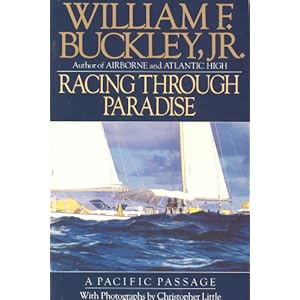
From the bookshelf: Racing Through Paradise -- Wm. F. Buckley, Jr.


As we noted at the time of William F. Buckley, Jr.’s passing some years back, Buckley is an MH hero. One of the great things for someone of a later generation who loved Buckley is that there is virtually no end to reading him, so prolific was his output during his lifetime. Every winter, during the months of February and March, Buckley repaired with much of his well-heeled clan to a former monastery in Switzerland, where Buckley used the peace and quiet that was possible in that unwired age to write or compile a book while National Review was left to fend for itself sans editor.

Some lucky underling at National Review would be tapped to join him as his literary factotum for the season (Buckley seemingly never stopped working, even on vacation, putting in 8-10 hour workdays writing and editing before allowing himself an hour's skiing prior to evening relaxation with family and guests,) and his publishers would be presented with a manuscript upon his return to New York -- a spy novel, a collection of his writings that had accumulated over the previous few years, an autobiographical book (i.e. those wonderful exercises in recounting a week in his life -- Cruising Speed and Overdrive,) or one of his sailing travelogues.

Having grown up in a part of the Wild West where a stock dugout is thought to be large body of water, MH’s eyes weren’t drawn to the sailing books until finding himself, due to circumstances beyond his control, in the middle of the Atlantic on islands that Buckley featured in Airborne, the first of the series (all now sadly out of print.)
Airborne was on prominent display in the local library, and it was quickly devoured. That was some time ago, but in the spirit of the modern age, where no used book that flits across one's fancy is more than a click away, we settled down recently with Racing Through Paradise, the third in the series, which had until now gone unread. Indulging in a book like this is like going down to one’s wine cellar and selecting a bottle that one has been saving for a special occasion -- the mood is right, and it is time to spend time with an old friend and reminisce.

Of Buckley’s four trans-oceanic passages, this was the only one to take place in the Pacific. His intrepid companions (most prominently featuring his son, the novelist Christopher Buckley) had by this point gone on one or both of Buckley’s previous trans-Atlantic sailings, and the Pacific was to give a change of pace, fresh scenery, and new challenges.

The first third of the book is a delightful recounting of more minor sailing excursions that Buckley and family had taken since the writing of the last sailing book, Atlantic High. A Christmas cruise in the Caribbean, flying to the Azores to sail amongst those beautiful islands (featured in the first books) with family members who weren’t up to the full challenge (or insanity) of crossing most of the Atlantic to reach them, excursions along the coasts of New England and the Maritime Provinces...

The rest of the book is devoted to the Pacific crossing itself -- going from Hawaii to New Guinea in a month.  There was a timetable to be kept, since one of the crew was President Reagan’s ambassador to France and needed to be back for diplomatic functions. This suited the restless Buckley just fine, who always seemed to be happier when on the move (perhaps a sea-captain's trait as well -- cf. Jack Aubrey.)

As is well-known, the Atlantic has far rougher and colder seas than the Pacific (hence the latter's name,) so much of the copious pain of this particular journey came from different things than encountered on the previous voyages, mostly the extreme heat and humidity of the tropics. The perils came in part from the vast Pacific’s far emptier reaches and the lack of electronic navigational aids in much of that expanse at the time.

In an era of GPS so precise that it is used to help orthopedic surgeons determine proper placement of metal hardware into bones in an operating room, and where one’s children give you that blank "haven't you heard of MapQuest" look when you offer to write down directions, it is easy to forget just how much depended, not that long ago, on an ability to navigate by old-fashioned methods.

Buckley being Buckley, with his fascination with technology (although rarely with a mastery of it,) one of this book’s interesting historical features is that he did have with him an early GPS prototype. Unfortunately, the web of GPS satellites that currently encases the earth in interlocking orbits did not yet exist, and access to the satellites that did exist over the Pacific was available only a couple of times a day.  Finding them, furthermore, required a precise identification of stars that itself presented a challenge. Here too, Buckley strikes again, with a computer program (home-brewed by friend and critic Hugh Kenner) for identifying said stars. In an exercise that is familiar with anyone who is using an early iteration of any technology that promises to make life oh, so convenient, Buckley finds that it takes him far more effort to learn where he is using high technology than if he were to depend on the celestial navigation techniques that he so ably described in an oft-reprinted chapter of Airborne. (A sort of “Navigation for Dummies” before that black-and-yellow series of how-to books existed.)

As with his other sailing books, though, the real story is one of relationships. One of the requirements that Buckley made of his sailing companions (other than the 3 professional crew members that were along for safety and comfort) was that each keep a journal during the passage, and Buckley draws extensively from these in the course of the book. Nice way to fill pages for an author and for the most part a boon for the reader as well, who would otherwise be restricted to Buckley’s accounts and his surmises of what the others were thinking. The device works best when there is an event (usually either humorous or dangerous) that can be usefully viewed from a variety of vantages simultaneously -- nautical versions of As I Lay Dying, so to speak.

It has weak points, though, especially where son Christopher’s journal is so manifestly more interesting than anything his “Pup” has to say that the narrative is turned over to him for too long, causing a loss of the continuity of seeing the journey through WFB’s eyes, which is what the reader primarily came for in the first place.

There are moments where one’s romantic bone is tickled -- cocktail hour at sunset every night begun by listening to a segment of David Niven’s recording of excerpts from his autobiography, followed by dinner prepared by a skilled on-board chef, capped with drinks and cigars, all leavened with endless conversation. On the other hand, one could more comfortably do the same in the comfort of a villa on dry land, free of pitching seas, emetic squalls, and stultifying heat and humidity -- and with comfortable rooms, private baths, fresh-water showers, and washing machines.

What in the end captivates both the participants and the reader, though, is the quest, the journey. Early in the volume we see, in the form of the Caribbean jaunts, that life on-board a yacht can (surprise!) be languorous, comfortable, and sedate. Buckley and companions could have done that for a month, in bucolic (can one use that in describing time spent on water?) comfort. But, what would be the challenge in that?  No, as Buckley pointed out early in the narrative, when the trip was being planned, what he wanted was an oceanic passage, not a pleasure cruise in the southern islands.  Indeed, by the end, participants and reader alike are excited at the conquest and yet loathe to see it end.  As an aside, one remembers old-timers talking of steamship crossings of the Atlantic in that manner, one has experienced it on long train journeys, but does one ever hear it about long airline flights?

Most are unlikely ever to cross an ocean in a yacht, but reading books like this reminds one of the quests that await friends wherever they are. Living in Montana, we are closer to such things than most. One remembers a golden day last summer, hiking with friends in the Beartooths. We had a quest -- to reach certain alpine lakes where cutthroats awaited us, aching to hit our flies and end up on our grill.

One thinks of long drives across Montana (do the destinations ever really matter as much as getting there?) with family, the only sounds in the vehicular monstrosity (not quite a land yacht -- that would be a motor-home) being effervescent conversation that skips and leaps across time and space...  as the endless vistas of rivers and mountains glide by outside our windows.

And those passages, like Buckley’s crossings, also sadly come to an end, with each dispersing upon disembarkation to lives led increasingly a little further apart from the others. We know, but try not to think about it, that someday there will be a last journey together, and tears.  But then the joy of remembering, of which books like this remind us that there need never really be an end.

Wednesday, November 21, 2007

Allan Bloom's Closing of the American Mind 20 years later


20 years ago, a bombshell hit the liberal educational establishment. A little-known University of Chicago professor wrote a book that was on the summer reading list of just about everyone in the chattering classes.

The Closing of the American Mind was subtitled: “How Higher Education has Failed Democracy and Impoverished the Souls of Today’s Students.”

The New Criterion, in honor of the 20th anniversary of the first appearance of this classic, devotes several essays revisiting the book in the November number. One of the things that is in short supply these days is serious criticism -- there is a lot of reviewing that goes on, but criticism requires a broadening of perspective. And it virtually demands some distance -- retrospective, if you will.

Bloom's book was itself a work of serious criticism -- albeit one that had a curious appeal to the more general reader. But then, the best serious criticism can stand the test of being exposed to the general serious reader, as opposed to the academic specialist.

Bloom's book ranged from his contemporary experiences teaching at a major elite university (drawing also on the formative moments of the student rebellion when he was teaching at Cornell) to ancient Greek philosophy to 19th century German nihilism. It brought perspective.

Of course, as with so many serious books, far more people bought it than read it. From Roger Kimball's essay:

But even the success of The Closing of the American Mind had its oddities. One side of the oddity was summed up by a cartoon in The New Yorker. It shows a bemused-looking chap in a bookstore. He is standing in front of a table piled high with the book. As he leafs through a copy, a bookseller stands by beaming and confides, “I haven’t read it, but it’s terrific.”

I have often wondered how many of those million copies sold actually found readers. Five percent? Seven? Not more, I’d wager. But the interesting thing is that it didn’t matter. Poetry, T. S. Eliot said, communicates before it is understood. Similarly, books like The Closing of the American Mind do not have to be widely read to touch a nerve and communicate their essential message.


In James Piereson's lead essay, we are reminded that one of the main themes of the book -- the importance of an education in the "great books" (i.e. the ones overwhelmingly written by dead, white males) -- was hardly a new one, since it had been addressed from within the liberal tradition since the 1930s.

What Bloom was saying was more root-and-branch, and was probably only possible because enough of a culture had developed outside of that liberal tradition that the reading public could conceive of an assault from outside that tradition without the assault being an anti-intellectual one.

Bloom, however, understood that trying to change the curriculum without addressing the more fundamental ideas that have shaped it would be like trying to cure a sick man simply by changing his diagnosis.

Bloom claimed that the West faces an intellectual crisis because no one any longer can make a principled defense of its institutions or way of life. This is most evident in the university, which has reformed itself according to the ideas of openness, tolerance, relativism, and diversity—all of which claim that no political principles, institutions, or way of life can be affirmed as being superior to any others.

This is the near-universal view among students and faculty at our leading institutions of higher learning. The tragedy here, according to Bloom, is that relativism has extinguished the real motive behind all education, which is “the search for the good life.” If all ideas and ideals are equal, there is little point in searching for the best ones.


One remembers the fury with which the book was attacked: which just made some of us recent college graduates all the more interested in what the fuss was about.

A retrospective like this, however, tells bits of the story that only the passage of time tends to send bubbling to the surface. For instance, did we know at the time that the book was written at the encouragement of Bloom's friend Saul Bellow? If so, it is lost in the mists of memory.

Certainly it was not common knowledge that the success of the book was almost certainly due to an unexpected change in editors between the time the book was accepted for publication and the time that editing actually began. The editor called for a snappier title (the original: Souls Without Longing,) and turned on its head the original academic structure that started with the ancients and moved to the modern. Instead, Bloom starts in medias res, with "his discussion of contemporary students, with his unsparing comments on their relationships, the books they read, and the music they like to hear..."

There, too, it is hard to remember that one of the hottest topics of debate about the book was actually Bloom's harsh indictment of rock music (an indictment that Roger Kimball, in his essay, takes up and expounds on in more general critical terms -- a fascinating discussion in and of itself.)

Or how about the fact that the book drew explicit parallels between the academy of the Nazi era and the radicalized academy of the 1960's and beyond?

Yet another thing that the perspective of two decades has yielded is that since this was practically the first book of its sort, the academy didn't see the book coming. As a result, the first major reviews were favorable. The NYT Book Review essay was by Roger Kimball (the contributor of one of the New Criterion essays,) and the editors of that publication helped things along by giving Kimball's review the title of "The Groves of Ignorance." Other favorable reviews quickly followed in the daily Times , the Wall Street Journal, and the Washington Post.

By the time anyone went on the counter-attack, it was too late, and the book had leaped to the best-seller list. The attacks on the book then only had the effect, as noted above, of attracting more attention from those who felt that things weren't quite right at America's major universities. Today, such a book would likely have been assigned unfavorable reviewers from the beginning at the major establishment organs. Overtly conservative books still tend to do quite well on the best-seller lists, but they tend to be "shock-jock" books of the Ann Coulter variety.

The end of the story isn't an entirely happy one for the lover of traditional education. While Bloom became a multi-millionaire and became an unlikely celebrity, and while generations of conservatives who followed would forever be emboldened in questioning liberal academic orthodoxies, Bloom's main goal went unfulfilled.

Bloom's primary concern was for the top few dozen universities in America, hoping that the course could be changed, and that there could be a return to liberal education (in the true sense) grounded in the classics and eternal verities. This most evidently did not happen.

But Bloom, of course, was looking at things from the only perspective he knew -- that of someone who had spent his entire academic life, from college student through professorship, in Ivy League level universities. As is often the case, it was probably difficult for him to conceive of the possibility that deep learning and thought can go on outside those elite institutions -- and indeed outside the university setting entirely.

Not surprisingly, one of the fruits of Bloom's work was a genuinely conservative one, in the modern sense where the importance of free enterprise and independence is emphasized. His book began a cascade of self-learning enterprises that ranges from home education of children to book clubs devoted to the great books of Western Civilization.

Who is to save, and pass on to the next generation, the classical learning of Western civilization? Look in the mirror.

Saturday, June 2, 2007

From the Bookshelf: Foreign trade and the local economy in Hesiod's Works and Days

Works and Days
By Hesiod

Works and Days is an intensely local work. As Victor David Hanson pointed out in The Other Greeks, a work touched on in the last Montana Headlines post on Hesiod, the 8th c. B.C. saw the rising of a type of an agricultural model which if not completely new, was at least unusual.

Agriculture, in Hanson's portrayal, had tended to be either the work of peasants engaged in subsistence farming or of what we would now call agribusiness -- large-scale estates run by wealthy absentee landowners. The world that Hesiod portrays (and that his contemporary, Homer, touched on in his approving mention of the nobleman Laertes working the soil on his hands and knees) is rather one of "middling" farmers who own their own land and work it with a hope of creating a modicum of wealth.

Wealth does not, of course, come from merely working to raise enough food to eat -- that is subsistence farming. The farmers of this era were engaged in producing excess to sell to the growing towns and cities. Those towns and cities created a demand for a reliable and increasing source of food, and the efficiencies created by what was simple free enterprise -- men of some talent and ambition choosing to toil tirelessly with their own hands -- provided that reliable source.

Hanson contends that this class of middle-class farmers, engaged overwhelmingly in meeting the direct needs of their city-state, were the source of much of Greece's rising wealth and power.

So it should come as no surprise that Hesiod's exhortations cast a wary eye on excessive attention to foreign trade, whether as a source of supply or of creating wealth:

The earth supports them lavishly; and on the hills
The oak bears acorns for them at the top
And honey-bees below; their woolly sheep
Bear heavy fleeces, and the their wives bear sons
Just like their fathers. Since they always thrive,
They have no need to go on ships, because
The plenty-bringing land gives them her fruit.

........

Add to your stores, and Famine, burning-eyed,
Will stay away. Even if your supply
Is small, and if you add a little bit,
And do it often, soon it will be big.
Less worry comes from having wealth at home;
Business abroad is always insecure.


Hesiod certainly sees a place for such trade -- and the Greeks were never afraid of being men in ships, plying the seas. But again, there is a time and place for it in Hesiod:

...keep in mind that all works have
Their proper seasons: sailing, most of all.

If you should turn your foolish mind to trade,
Longing to flee from debts and painful want,,
I'll teach the measures of the sounding sea...


And although Hesiod, ever the entrepreneur, advises that one should "admire small ships, but put your cargo in a big one, for a larger cargo brings a larger profit, if the storms hold off," he also makes clear that wisdom dictates that wise trade should involve the true excesses of a land's production:

I ask, consider what I say: Do not
Put all your fortune into hollow ships,
Leave most of it behind, and load on board
A smaller share, for it is terrible
To meet catastrophe among the waves
At sea, and terrible to load too great
A weight upon your wagon, and to break
An axle, and have all your cargo lost.
Preserve a sense of right proportion, for
Fitness is all-important, in all things.


Saturday, May 26, 2007

From the bookshelf: Hesiod and early Greek agrarian thought

Works and Days
By Hesiod

There are many places where one could start in examining the literature devoted to agriculture and the agricultural life, but one of the most natural is Hesiod’s Works and Days.

Dating back to the age of Homer in the 8th c. B.C., Works and Days has a surprising familiarity, in no small part because it is written from the point of view of a small landowner who lives and works the ground, raises his livestock, watches the weather and seasons, and pays close attention to the importance of piety – neither offending the gods nor omitting reverence toward them.

The familiarity begins immediately with an upfront portrayal not of idyllic fauns and satyrs prancing in forest glades – but with strife. One kind of strife is the cruel one – war. The other is one is a positive force, albeit one that requires no less effort and attention


Set in the roots of earth, an aid to men.
She urges even lazy men to work:
A man grows eager, seeing another rich
From ploughing, planting, ordering his house;
So neighbour vies with neighbour in the rush
For wealth: this Strife is good for mortal men –


…Do not let Wicked Strife persuade you, skipping work,
To gape at politicians and give ear
To all the quarrels of the market place.
He has no time for courts and public life
Who has not stored up one full year’s supply
Of corn, Demeter’s gift, got from the earth.
When you have grain piled high, you may dispute
And fight about the goods of other men.
But you will never get this chance again…


And with that note of warning from Hesiod to pay attention to business, Montana Headlines really should sign off, since there is still work to be done outside around here while it is still light. But first, a couple of comments:

One of the most intriguing modern scholars of the agrarian life of the classical world is Victor David Hanson, a professor of classics at a California university. Conservatives may be more familiar with his essays on military issues for National Review and other publications -- his dual interests of agriculture and war are rooted in Hanson's scholarship, in which he traces the roots of the independent Greek city-state not to the slaveholding and philosophizing aristocracy, but rather to the independent farmer/warrior hoplite.

America, too, was founded by men who revered hard work, who viewed the ownership of land as central to the success of the Republic, and who put down the plow and left their land to take up arms when necessary for the defense of their homeland. Until well into the 20th century, this remained a familiar pattern.

At some point, Montana Headlines will review some of Hanson's books in greater depth, but Hanson has this to say about the rise of Greek agrarianism in his classic work The Other Greeks: The Family Farm and the Agrarian Roots of Western Civilization, saying that there was in the 8th c. B.C. --

...a transformation of the mind, a radical change of attitude... This alteration in the Greek mentality involved a new ideology of work derived from land ownership, not tenancy.

More specifically, it entailed an idea that manual labor, time spent on the soil, was both intrinsically ennobling, moral if you will, and a wise economic investment that would lead (not necessarily in one's own lifetime) to greater agricultural production and hence more wealth for coming generations.


Moral and ennobling -- yet Hesiod has a certain cold and unflinching realism about the rigors of rural life and the realities of human nature that complicate an already difficult task. Like any farmer or rancher today who makes a living from the land, Hesiod doesn't romanticize the life.

A modern-day farmer or rancher will rarely speak in words about the moral and ennobling aspects of what he does, but he will tell you about it through action -- tenaciously holding on to land and a way of life regardless of prospects for financial success. And his actions will usually show that he, like Hesiod, takes the long view, thinking about how to make it possible for at least one child to continue with that way of life. Hesiod likewise makes it clear that the ancient Greek farmer, at least in the Homeric era with its rise of small landholders, wasn't just doing it for the money.

There was also a fall of the Greek small farmer -- and that is part of Hanson's story as well, a story that will resonate with anyone with ties to American rural life. But that is for another day.