Showing posts with label National Review. Show all posts

Friday, August 3, 2012

From the bookshelf: Peace, They Say -- by Jay Nordlinger


Update: Here is a link to my main review of this book in the journal Touchstone, that was published later (Jan 2013).

* * * * *

With more than a century’s worth of laureates to choose from, Jay Nordlinger (a senior editor at National Review and music critic for The New Criterion) has said that some well-meaning friends advised him to write only about the interesting ones in Peace, They Say, his history of the Nobel Peace Prize. The trouble with that approach, he says, is that the laureates are all interesting – one doesn’t win “the most famous and controversial prize in the world” by having lived a boring life.

Besides an author’s understandable desire for completeness, however, one suspects that another reason for including at least a short account of every laureate from the founding of the Nobel Peace Prize at the dawn of the last century through the crowning farce of President Obama’s selection in 2009 (he was nominated shortly after taking office) was to put the achievement of this award into a certain mildly skeptical context, since the more deserving laureates stand out clearly from the crowd.

Nordlinger groups decades worth of Nobel Prize winners into chapters he calls “parades” (echoing the Oslo torchlight parade that is held in honor of the winning laureate,) interspersing these chapters with fascinating background material such as the actual nuts and bolts of the selection process, a biography of Alfred Nobel himself, reflections on why certain seemingly obvious candidates weren’t selected, and disquisitions on the meaning of the word “peace.” While all of the winners are indeed interesting, all too many prize winners are interesting in almost everything except for the real reasons they won the prize.

The most memorable highlights of the book are when a personality periodically breaks through the mind-numbing strings of organizers, activists, relief workers, and professional moralizers, arresting our attention with sheer (dare one say it?) manliness. One is Fridtjof Nansen, a Norwegian who won in 1922. He was a “scientist, explorer, athlete, professor, diplomat, executive, humanitarian,” and Nordlinger describes him as being a more accomplished Indiana Jones, with the additional quality of actually being real. He broke a world speed-skating record, charted the Arctic, was Norway’s first ambassador to Great Britain, curated the Bergen Museum, and engaged in a series of humanitarian missions around the globe at the request of the League of Nations, beginning with taking charge of repatriating hundreds of thousands of prisoners of war to their native lands after the Great War of 1914-1917.

Another is Ralph Bunche, a Detroit native who was a high school sports star and valedictorian, going on to UCLA on a basketball scholarship, where he was again a sports star and valedictorian. Then, on to Harvard and two graduate degrees -- all of this achieved by a black man living c. 1920 in a pre-affirmative action America. Bunche’s politics tended toward the radical in his early days, according to Nordlinger, but unlike so many radicals of his time, he had the awareness to recognize when organizations were controlled by the Communist Party and the good sense to avoid them. After serving in the American intelligence services during WWII, he went on to work for the State Department and then the U.N., where he found himself as the chief mediator between the newly-formed state of Israel and several neighboring Arab states. As with all such efforts in the Middle East, the resulting peace was short-lived, but Bunche stands out for the remarkableness of his personal story, irrespective of his personal politics or the transience of the achievements for which he received the Nobel.

Early winners of the Nobel Peace Prize tended to be idealistic sorts with great fondness for committees, associations, treaties, conferences, and arbitration. Their naïveté is almost touching, knowing what we do about the coming bloodbath that was the Great War, an event that flicked members of the peace movement away like so many fleas.

It is a bit embarrassing, really, to see the silly utopianism of American Secretary of State Frank Kellogg (the 1928 winner) who “outlawed war” with the Kellogg-Briand Pact– a document that in its bearing on reality resembles a court injunction to shut down the earth’s gravitational field. Such laureates were, however, acting at least in part in the spirit of Alfred Nobel, the founder of the prizes that still bear his name today, and who viewed war as the “horror of horrors.”

Nordlinger’s account of Nobel’s life is one of the most intriguing stories in the book, painting a much more complex portrait of the man than the commonly encountered one – namely, that he was a man who felt so guilty about inventing (and spending a lifetime manufacturing and selling) the dynamite that was used in arms-making that he established these prizes to relieve his sense of guilt. While this story fits modern liberal sensibilities and guilt-complexes, it isn’t true.

Nobel as Nordlinger portrays him is a man such as our own age seems unlikely to produce: a polymath and polyglot, deeply read in literature, an amateur but dedicated writer and translator – and all the while, a brilliant scientific inventor and entrepreneur and a hugely successful industrialist unashamed of his accomplishments and of the wealth he accumulated.

While Nordlinger conveys that Nobel’s political views were complex and sometimes contradictory, of interest is his observation that Nobel was “skeptical of democracy, and of the mob,” sentiments that would be abhorrent to those who control the Peace Prize today. Also contrary to the views of many of laureates, Nobel believed that demanding disarmament was “really only to make oneself ridiculous without doing anyone any good.” On one point, Nobel showed a certain prescience: he believed that once weapons became powerful and terrible enough, nations would be forced, out of self interest, to stop going to war. Nordlinger terms this a point of “innocence” on Nobel’s part, but in a sense Nobel was right. Once large stores of nuclear weapons were accumulated, direct war between great powers became a thing of the past. Traditional wars with guns and bullets largely took place on the periphery of the Cold War, and even afterwards wars between nuclear powers have been avoided.

The Prize has evolved into something highly political, and few things show this more clearly than the fact that the last three Democratic administrations contain Nobel laureates (Presidents Obama and Carter, and Vice President Gore.) The last award to someone in a Republican administration (given to Henry Kissinger in 1973 for his work in peace talks with North Vietnam) is, according to Nordlinger, the most unpopular in the history of the Peace Prize.

Perhaps an even greater source of irony is the fact that President George W. Bush, regardless of how history will view his tenure in office, managed to achieve a certain level of immortality in the world of the Nobel Peace Prize by being responsible, in whole or in part, for no fewer than 6 awards. The committee despised him so much that they seem to have been unable to resist giving awards that would be seen as a slap in Bush’s face.

The series of “anti-Bush” awards started with a sort of pre-emptive “warning” award after 9/11, with the run being interrupted only long enough to give the prize to a tree-planter in Kenya (2006) and a Third World “microloan” specialist (2008) -- awards that serve almost as comic relief from the otherwise tedious obsession with Bush during that decade. The awards to former VP Gore (2007) and to the newly-elected President Obama (2009) brought the art to new heights, combining anti-Bush animosity with specious grounds for being given the award (Mr. Gore for his global warming activism and Mr. Obama for not being Mr. Bush.)

Even someone skeptical about the value of the Nobel Peace Prize has to admit that the history of this award is fascinating, especially when presented in the way that Nordlinger does. He highlights obscure laureates who have been unjustly forgotten, and he shares anecdotes about even the best-known selections. In one instance, we learn that Lech Walesa may have owed his award to a handful of Polish protesters at the previous year’s ceremonies, accusing the Nobel Committee of being afraid of challenging the Soviets on anything. In another, he notes that the same committee that gave the award to Begin and Sadat wanted to include President Carter, who had helped broker the talks – but couldn’t, because no-one anywhere on the globe had nominated him.

Nordlinger’s predictions for where the Nobel Peace Prize will go from here tend toward more of the same, including new fashionable causes that will stretch even further what “peace” is, as defined by the committee. Even though skepticism is a subtext of the book, he unfailingly treats both Prize and laureates with the respect and decorum that is a trademark of Nordlinger’s writings. He has to be one of the few writers who could induce this reader to read and thoroughly enjoy a history of the Peace Prize.

* * * * *

Note: There is a lot to say about this fine book. My main review (equally laudatory) of this book will be appearing in an upcoming issue of Touchstone magazine. I'll provide details when it appears -- a link if available, or a reprint on this website 90 days after it appears, as per that magazine's guidelines.


Monday, May 14, 2012

Jay Nordlinger on the oil boom in North Dakota -- the Bakken, Microsoft, and more

Another "Bakken Monday" at MH:

Readers of the dead-tree edition of National Review will likely already have read Jay Nordlinger's article on the oil boom in North Dakota. For those who haven't, go out and buy a copy -- it is well worth the price for that article alone.

For those whose local bookstores have sold all their copies, Nordlinger has a series of interesting posts on NRO -- but be warned, they do not in any way comprise a précis of the heavy-duty article itself. Like most of Nordlinger's "Impromptus" columns on NRO, they are rather a fascinating series of brief (often light) anecdotes and observations . (Click on Part I, and follow through all 5 parts.)

Nordlinger, who has been mentioned on this site before in his capacity as music critic for The New Criterion, has the "day job" of senior editor for NR (rough life for a conservative journalist and pundit.)

He doesn't gloss over the problems that have come along with the oil boom surrounding the Bakken play, but he also conveys the infusion of money and energy (the human kind) that this development has brought to the state. Many of the people that he interviewed were people who had moved away from the state as youths (a problem endemic to states like North Dakota and Montana) but who are now able to move back because of the availability of jobs and business opportunities.

An interesting tidbit that Nordlinger reports on is that North Dakota's pro-business climate hasn't just manifested itself in the world of energy. Microsoft's second largest campus in the U.S. is in Fargo, and in fact, the fastest growth in jobs has taken place not in western ND where the oil boom is taking place, but rather in Fargo, which is about as far from the oil-fields as you can get and still be in the state.

Former North Dakota governor Ed Schafer demurs when people refer to the "North Dakota miracle," pointing out that it was a long, hard "slog" to get to where the state is now, revamping the state's entire attitude toward business and economic development, a process that started in the 1990's and is now bearing fruit.

An interesting post on the topic of broader economic development in ND can be found at Daily Markets, which mentions the Microsoft presence as well as Amazon's new 30,000 sq ft facility in Fargo, and then goes on:

Manufacturing continues to grow in North Dakota. One example is the recent expansion announcement by Caterpillar in West Fargo. Construction has started on a $50 million project that will create about 250 new jobs during the next three years, nearly doubling the plant’s current workforce. Caterpillar officials told us that North Dakota’s pro-business climate was a major factor in its decision to expand in West Fargo.

Phoenix International, a company that manufactures electronics for John Deere, recently broke ground on a $22 million expansion project that will include 90,000 additional square feet in Fargo for an expanded work force.

Other industrial expansions include WCCO Belting in Wahpeton, Harris Manufacturing in Oakes, and at the Monsanto and Cargill facilities in the Fargo area. Cargill recently started a $50-million expansion project and Monsanto has completed a $17.5 million expansion that has created 20 new jobs.

There are those who want Montana to try to attract "green jobs," high-tech industry, or even manufacturing instead of promoting the grubby business of extracting coal, oil, and natural gas from the ground. The reality is that in order to attract business, a state needs a "grub-stake," as the old time prospectors used to call it. "Only" 25% of state revenue comes from energy in North Dakota, but what that revenue allows for is tax structures that promote other kinds of business development in the state. Broad-based economic growth requires a positive attitude toward business in general, and the North Dakota experience is proving that.

If Montana starts landing major campuses for companies like Microsoft and Amazon, or breaking ground for manufacturing facilities for companies like Caterpillar, while leaving the coal and oil in the ground, MH will stand corrected. Until then, we can predict that our big growth industries will remain jobs in the state Department of Revenue and at fast-food joints that serve tourists driving through on I-90. And of course our kids in Billings can get jobs at Costco and Best Buy selling things to people driving up from Wyoming to shop for the weekend.

A final note: on the Republican side of things in Montana, it is tempting to talk about oil and coal development in isolation, promising to use those monies to cut taxes for Montanans. While that is all well and good, it is a formula for the "boom-bust" cycle that everyone rightly fears.

The economic development effort needs to be waged along a much broader front than simply coming up with policies that specifically promote drilling and mining. Attention needs to be paid to the entire spectrum of items -- legal, regulatory, taxation, infrastructure, education, quality of life -- that affect whether anyone would be inclined to start a company in Montana or to move a company to our state.

Sunday, April 29, 2012

Mark Steyn on Governor Brian Schweitzer and other sophisticates

(A quick note on the photo: MH has long maintained that Jag is a good Republican dog doing his best with what has been served up. As always, we wish him good health and long life.)

So, not only does Montana’s Governor Brian Schweitzer have to suffer the ignominy of not being able to dodge questions even in friendly environs like David Letterman’s show regarding his “polygamy commune” jab at Mitt Romney, he now gets to play the leading man in a Mark Steyn column at National Review. Quite a week of auditioning for the governor's next gig -- is this really a good strategy for maneuvering Sen. Baucus into retirement to open up that seat?

We had the “dog wars,” where the fate of the Republic apparently depended on what Americans will find more viscerally repulsive -- a President who ate dog meat as a boy or a would-be President who transported his dog in a carrier on top of his car. Who “won” that debate? It’s hard to care, really, and the fact that the Obama camp picked the fight and the Romney camp finished it isn’t particularly meaningful, let alone gratifying, to anyone but the most hardened partisans of either.

Neatly pivoting from that bit of statesmanship, we have the President’s coterie dispatching one of his surrogates (any governor making public statements of this sort is a surrogate -- we may be simple folk around here, but we’ve figured that much out,) casually bringing up Mormon polygamy in the Romney family tree. Only the obdurate would refuse to acknowledge that if you scratch anyone of old-Mormon blood, polygamist lineage will be found somewhere underneath. It is as remarkable as observing that a resident of the District of Columbia votes Democratic.

What is quite remarkable, however, is that the Obama camp should choose this moment, when they are grumpily complaining that young Barack didn’t have any choice about eating the dog set before him, to use something over which Governor Romney had even less control (children have been known occasionally to refuse to clean off their plates, while LDS time-travel has yet to be invented) to prod at a culturally sensitive spot for Mormons, in what can only be an initial probe to see whether this dog can be hunted... to return twistedly to a previously mentioned theme.

We, being sensitive sorts around here, really do have some sympathy for the governor in this matter -- it was a dirty job that someone in the Obama campaign wanted done, and it is perhaps an indication of the esteem in which the governor is held by the administration that he was selected to do it. The conspiratorially-minded might see the hand of long-time Baucus aide and ally (and current Obama campaign manager) Jim Messina in this assignment -- but we digress.

Suffice it to say that surrogacy is a sometimes slimy business -- recall, if you will, Mitt Romney sending out surrogate U.S. Senators to blast Rick Santorum for voting for bills they themselves had voted for. The higher you are on the campaign’s totem pole, the more positive you get to be in your media appearances advocating for the candidate, and the lower you are, well, the more likely you are to get stuck with mud-throwing bits like the polygamy beat, figuring out how to blend in a poll that (newsflash!) says 86% of American women don’t approve of polygamy.

Steyn, characteristically, avoids all of this nice analysis and goes straight for the jugularic facts:

Just for the record, Romney’s father was not a polygamist; Romney’s grandfather was not a polygamist; his great-grandfather was a polygamist. Miles Park Romney died in 1904, so one can see why this would weigh heavy on 86 percent of female voters 108 years later.

Meanwhile, back in the female-friendly party, Obama’s father was a polygamist; his grandfather was a polygamist; and his great-grandfather was a polygamist who had one more wife (five in total) than Romney’s great-grandfather. It seems President Obama is the first male in his line not to be a polygamist. So, given the “gender gap,” maybe those 86 percent of American women are way cooler with polygamy than Governor Schweitzer thinks. Maybe these liberal chicks really dig it.

And again, Steyn being Steyn, he has some other uncomfortable observations that really are more directed at smugly multi-cultural liberals than they are at anyone’s political campaign:

...self-loathing cultural relativism is so deeply ingrained on the left that any revulsion to dog-eating is trumped by revulsion to criticizing any of the rich, vibrant cultural diversity out there in Indonesia or anywhere else.

Most polygamy in the developed world has nothing to do with Mormons: It’s widely practiced by Western Muslims, whose plural marriages are recognized de facto by French and Ontario welfare departments and de jure by Britain’s pensions department. But “edgy” “transgressive” leftie comics on sad, pandering standup shows will reserve their polygamy jokes for Mormons until the last stern-faced elder in Utah keels over at the age of 112.

In the United Kingdom, 57 percent of Pakistani Britons are married to their first cousins, with attendant increases in their children’s congenital birth defects. But the comics save their inbreeding jokes for stump-toothed West Virginians enjoying a jigger of moonshine and a bunk-up with their sisters.

The editor of Washington’s leading gay newspaper was gay-bashed in Amsterdam, “the most tolerant city in Europe,” but by Muslims rather than the pasty rednecks who killed Matthew Shepard, so liberals don’t have a dog in this fight.

Being on the receiving end of selective ridicule should be familiar territory for us Republicans, who are, by definition, less sophisticated than our liberal betters, and hence deserving of satire. Columns like Steyn’s won’t change any behavior on the left when it comes to deciding who can be lampooned safely and who needs to be tiptoed around. In fact, if ever any proof was needed that supposedly irrational gun-clinging Americans really aren’t that terrifying to the washed, contrast the kid-glove treatment of Muslim sensibilities with the steady diet of redneck ridicule coming from the clever set.)

Still, columns like Steyn’s serve a certain purpose: they confirm that, no, we aren’t crazy -- there really is a double-standard when it comes to the left’s self-proclaimed pieties of treating other cultures with respect.

Thursday, April 12, 2012

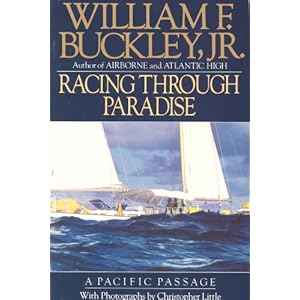
From the bookshelf: Racing Through Paradise -- Wm. F. Buckley, Jr.


As we noted at the time of William F. Buckley, Jr.’s passing some years back, Buckley is an MH hero. One of the great things for someone of a later generation who loved Buckley is that there is virtually no end to reading him, so prolific was his output during his lifetime. Every winter, during the months of February and March, Buckley repaired with much of his well-heeled clan to a former monastery in Switzerland, where Buckley used the peace and quiet that was possible in that unwired age to write or compile a book while National Review was left to fend for itself sans editor.

Some lucky underling at National Review would be tapped to join him as his literary factotum for the season (Buckley seemingly never stopped working, even on vacation, putting in 8-10 hour workdays writing and editing before allowing himself an hour's skiing prior to evening relaxation with family and guests,) and his publishers would be presented with a manuscript upon his return to New York -- a spy novel, a collection of his writings that had accumulated over the previous few years, an autobiographical book (i.e. those wonderful exercises in recounting a week in his life -- Cruising Speed and Overdrive,) or one of his sailing travelogues.

Having grown up in a part of the Wild West where a stock dugout is thought to be large body of water, MH’s eyes weren’t drawn to the sailing books until finding himself, due to circumstances beyond his control, in the middle of the Atlantic on islands that Buckley featured in Airborne, the first of the series (all now sadly out of print.)
Airborne was on prominent display in the local library, and it was quickly devoured. That was some time ago, but in the spirit of the modern age, where no used book that flits across one's fancy is more than a click away, we settled down recently with Racing Through Paradise, the third in the series, which had until now gone unread. Indulging in a book like this is like going down to one’s wine cellar and selecting a bottle that one has been saving for a special occasion -- the mood is right, and it is time to spend time with an old friend and reminisce.

Of Buckley’s four trans-oceanic passages, this was the only one to take place in the Pacific. His intrepid companions (most prominently featuring his son, the novelist Christopher Buckley) had by this point gone on one or both of Buckley’s previous trans-Atlantic sailings, and the Pacific was to give a change of pace, fresh scenery, and new challenges.

The first third of the book is a delightful recounting of more minor sailing excursions that Buckley and family had taken since the writing of the last sailing book, Atlantic High. A Christmas cruise in the Caribbean, flying to the Azores to sail amongst those beautiful islands (featured in the first books) with family members who weren’t up to the full challenge (or insanity) of crossing most of the Atlantic to reach them, excursions along the coasts of New England and the Maritime Provinces...

The rest of the book is devoted to the Pacific crossing itself -- going from Hawaii to New Guinea in a month.  There was a timetable to be kept, since one of the crew was President Reagan’s ambassador to France and needed to be back for diplomatic functions. This suited the restless Buckley just fine, who always seemed to be happier when on the move (perhaps a sea-captain's trait as well -- cf. Jack Aubrey.)

As is well-known, the Atlantic has far rougher and colder seas than the Pacific (hence the latter's name,) so much of the copious pain of this particular journey came from different things than encountered on the previous voyages, mostly the extreme heat and humidity of the tropics. The perils came in part from the vast Pacific’s far emptier reaches and the lack of electronic navigational aids in much of that expanse at the time.

In an era of GPS so precise that it is used to help orthopedic surgeons determine proper placement of metal hardware into bones in an operating room, and where one’s children give you that blank "haven't you heard of MapQuest" look when you offer to write down directions, it is easy to forget just how much depended, not that long ago, on an ability to navigate by old-fashioned methods.

Buckley being Buckley, with his fascination with technology (although rarely with a mastery of it,) one of this book’s interesting historical features is that he did have with him an early GPS prototype. Unfortunately, the web of GPS satellites that currently encases the earth in interlocking orbits did not yet exist, and access to the satellites that did exist over the Pacific was available only a couple of times a day.  Finding them, furthermore, required a precise identification of stars that itself presented a challenge. Here too, Buckley strikes again, with a computer program (home-brewed by friend and critic Hugh Kenner) for identifying said stars. In an exercise that is familiar with anyone who is using an early iteration of any technology that promises to make life oh, so convenient, Buckley finds that it takes him far more effort to learn where he is using high technology than if he were to depend on the celestial navigation techniques that he so ably described in an oft-reprinted chapter of Airborne. (A sort of “Navigation for Dummies” before that black-and-yellow series of how-to books existed.)

As with his other sailing books, though, the real story is one of relationships. One of the requirements that Buckley made of his sailing companions (other than the 3 professional crew members that were along for safety and comfort) was that each keep a journal during the passage, and Buckley draws extensively from these in the course of the book. Nice way to fill pages for an author and for the most part a boon for the reader as well, who would otherwise be restricted to Buckley’s accounts and his surmises of what the others were thinking. The device works best when there is an event (usually either humorous or dangerous) that can be usefully viewed from a variety of vantages simultaneously -- nautical versions of As I Lay Dying, so to speak.

It has weak points, though, especially where son Christopher’s journal is so manifestly more interesting than anything his “Pup” has to say that the narrative is turned over to him for too long, causing a loss of the continuity of seeing the journey through WFB’s eyes, which is what the reader primarily came for in the first place.

There are moments where one’s romantic bone is tickled -- cocktail hour at sunset every night begun by listening to a segment of David Niven’s recording of excerpts from his autobiography, followed by dinner prepared by a skilled on-board chef, capped with drinks and cigars, all leavened with endless conversation. On the other hand, one could more comfortably do the same in the comfort of a villa on dry land, free of pitching seas, emetic squalls, and stultifying heat and humidity -- and with comfortable rooms, private baths, fresh-water showers, and washing machines.

What in the end captivates both the participants and the reader, though, is the quest, the journey. Early in the volume we see, in the form of the Caribbean jaunts, that life on-board a yacht can (surprise!) be languorous, comfortable, and sedate. Buckley and companions could have done that for a month, in bucolic (can one use that in describing time spent on water?) comfort. But, what would be the challenge in that?  No, as Buckley pointed out early in the narrative, when the trip was being planned, what he wanted was an oceanic passage, not a pleasure cruise in the southern islands.  Indeed, by the end, participants and reader alike are excited at the conquest and yet loathe to see it end.  As an aside, one remembers old-timers talking of steamship crossings of the Atlantic in that manner, one has experienced it on long train journeys, but does one ever hear it about long airline flights?

Most are unlikely ever to cross an ocean in a yacht, but reading books like this reminds one of the quests that await friends wherever they are. Living in Montana, we are closer to such things than most. One remembers a golden day last summer, hiking with friends in the Beartooths. We had a quest -- to reach certain alpine lakes where cutthroats awaited us, aching to hit our flies and end up on our grill.

One thinks of long drives across Montana (do the destinations ever really matter as much as getting there?) with family, the only sounds in the vehicular monstrosity (not quite a land yacht -- that would be a motor-home) being effervescent conversation that skips and leaps across time and space...  as the endless vistas of rivers and mountains glide by outside our windows.

And those passages, like Buckley’s crossings, also sadly come to an end, with each dispersing upon disembarkation to lives led increasingly a little further apart from the others. We know, but try not to think about it, that someday there will be a last journey together, and tears.  But then the joy of remembering, of which books like this remind us that there need never really be an end.

Tuesday, April 10, 2012

John Derbyshire, Joe Sobran -- Sigh...

We note that Rich Lowry at National Review announced this past weekend that John Derbyshire has been fired over an exhaustively offensive piece the latter wrote in Taki’s web magazine. Yes, it was clearly meant to be a satirical piece directed at articles describing “The Talk” that many black parents report giving their children about making their way safely in the world of whites. We are connosieurs of good satire here at MH, and Derbyshire’s piece frankly bombed if its mission was to be deftly and wickedly effective. Humor does not excuse offensiveness, but it can mitigate the crime, as anyone who enjoys Jon Stewart at his best knows.

Frankly, we are surprised that Derbyshire lasted as long as as he did at National Review. As Derbyshire himself knew (we know this because he wrote it,) opinion journals on the right simply cannot afford a tinge of bigotry if they are to be treated seriously. One suspects that several things innoculated him for a time from being written out of NR for his politically incorrect views and even more politically incorrect ways of talking about them.

First, he is English and has a British accent. As Derbyshire has pointed out (we discovered this quotation when doing background for this post,) being British has its advantages:

British people get status points in urban U.S. society just on account of being British. (Yes, of course it’s absurd, but I assure you it is the case.)
Second, he is married to a Chinese woman and is very knowledgeable about all things Asian. So he can’t be a very committed racist, right?

Third, he is an self-described admirer of everything Jewish. Given that the racist fever-swamps of the right have tended to be equal-opportunity places of anti-Semitic and anti-anyone-with-dark-skin sentiments alike, he was an unlikely candidate for making a racist label stick easily.

Fourth, he is an avowed atheist, and we all know that devoutly Christian folks are the racists, while atheism predisposes one toward tolerance, correct?

Fifth, Derbyshire is incredibly smart -- we knuckledraggers have few enough smart people around as it is. His literary and historical allusions are legion, unpredictable, invariably apt, and witty far more often than not.

But, there seems to be something in the disposition of a certain kind of provacateur that pulls toward the precipice, and eventually it is discovered that, yes, one does eventually fall over the edge if one keeps inching that direction. It is sad, since Derbyshire was a big part of shaking things up at NR over the past decade. As we noted in a past post a few years ago, after a long dry spell of stultifying conformity:

We're glad to see that NR shows a few signs of getting back to the good old days of quasi-chaos, when internal dissension was more common in the conservative movement, and when lock-step talking points were something the left engaged in.

Our sadness is not that Derbyshire was fired -- the MH zero-tolerance policy on racism is nothing new, and Lowry absolutely did the right thing in pulling the plug. The sad thing is that in reaction to this episode, we may head back into the kind of boring writing that engulfed NR after the (necessary) purge of Joe Sobran and censure of Pat Buchanan in the early 1990’s.

No, that’s really not true, upon reflection, as tears start to well up in MH eyes (and no, they aren’t just metaphorical.) Boring prose is not the saddest thing that can result from something like this, and remembering Joe Sobran reminds us why.

Joe Sobran was a brilliant man and a brilliant writer, and it was hard not to love the man in his early years if you were a conservative. William F. Buckley, Jr. discovered him as a starving graduate student in Michigan, and he quickly worked his way to the top levels of the National Review editorial board. His columns had spark and they had depth. Buckley loved the man, and so did most of us who were faithful readers of National Review.
 
Something happened to him, though, and he became mentally unhinged. At the time, many thought that he was being unfairly persecuted for his vocal and lonely opposition to the first Iraq War, which was entered into by a Republican President and was strongly supported by nearly all of the conservative journals and think-tanks. His subsequent career, however, demonstrated that he had, indeed, become captive to anti-Semitic and racist obsessions of the worst kind. What it must be like to be consumed with that kind of hate is unimaginable, and to watch someone descend from being an apparently normal moral human being into that world has to be a bit like watching someone you love become a meth addict -- surely for the most part, bigots and addicts alike are made (self-made, if nothing else,) not born. It isn’t predetermined; it doesn’t need to happen.

In the spirit of “hate the sin, love the sinner,” it is worth repeating Joseph Bottum’s brief obituary in First Things that we discovered today:

Joe Sobran has slipped away, dying at age sixty-four. What can one say? He was a polymath, a genius, and a sometimes brilliant writer of enormous speed and fluidity. And he drove himself nearly mad, embracing conspiracy theories and the crankiest of ways to reject consensus—from the authorship of Shakespeare’s works on down.

His life was filled with unhappy incidents, which may have been what pushed him to the battles he constantly forced on his friends, but he remained constant in his faith.

May he be taken home to God, where all those battles cease and every tear is wiped away.

Why indulge in memories of Joe Sobran, someone most readers of MH have never heard of, especially since we at MH didn’t even know he died two years ago until doing a search about him for this column? Mainly this: one sincerely hopes that Derbyshire is someone who was having at it in a British satirical way, tweaking tender American sensitivities until it finally got out of hand.  If so, that will be apparent in his future writing.

One suspects that Derbyshire is a very different animal from Sobran. If, however, there is a part of him that is susceptible to genuine racial antipathies, one hopes that he can shed it and climb back up the cliff. Not for the sake of his career as an opinion journalist, but for his sake as a human being. Watching Sobran spiral into the darkness of anti-Semitic obsessions after his firing from NR was like watching a spiritual horror movie. We know how that movie ends, and we really don’t want to see it again.