Friday, January 25, 2013

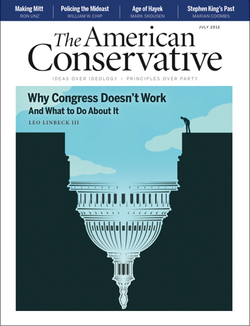
My recent piece in The American Conservative

I have mentioned before that The American Conservative is worth reading because it contains elements of an old-fashioned conservatism that one doesn't find anymore in the "mainstream" conservative media outlets. Love it or hate it, it can never be accused of taking any kind of a party line.

I hadn't been on its website for awhile over the holidays, and I had lost track of a review that I had submitted to that magazine last fall. It was only when the check arrived in the mail from The American Conservative that I realized it had been published.

It is a review of Roger Scruton's latest book, How to Think Seriously About the Planet.

Here's the link -- enjoy.

Wednesday, January 16, 2013

Back in the saddle for now -- and agreeing with Sen Tester?

Well, it has been a bit since I've posted. Funny how easily one can get used to not writing something three times a week. It was a full Christmas season, jam-packed with family, church, music, and life. Depression over the state of the nation has faded into irrelevance, and we didn't go over the taxation "fiscal cliff" as I had expected. One takes one's comforts where one can find them.

I really haven't been following much regarding the legislature, but I noted that I was somewhat in agreement with Sen. Jon Tester in his remarks to the Montana legislature. Not about all of that bipartisan stuff -- when Democrats say "bipartisan" they usually mean "go along with what we think." And not about his grandstanding on "Citizen's United" and all that. But this line:

Don’t focus on division and distraction.

We have already seen some goofy stuff -- the ever-reliable Jerry O'Neil wanting to be paid in gold, for instance. Or how about Sen. Jason Priest's suggestion to shrink the size of the Montana legislature? Neither thing is particularly harmful. It is just the kind of silly stuff that the Montana press loves to write about -- and why not? It makes for great theater.

Just once I'd love to see a hard-nosed Republican majority go to work on an exclusively economic, legal, and regulatory agenda made up of common-sense stuff that would be difficult to assail from the left.

We have a Democratic U.S. Senator addressing the Montana legislature saying that at the federal level, every spending program needs to be on the table -- i.e. the chopping block. Let's have a Republican legislature put that into play. Put every department and every expensive program on the table here in our state. Do some significant (but not over-the-top) trimming, and quote Sen. Tester at every turn about how everything needs to be "on the table." Let the opposition howl and be the ones to be unreasonable for a change.

Leave the controversial and divisive social issues alone for a term. Leave at home, for once, those items that amount to nothing more than picking fights or picking nits regarding battles lost long, long ago. (Yes, I'm talking about you, Rep. O'Neil.)

The truth of the matter is that if Republicans take Sen. Tester's admonition to heart and "don't focus on division and distraction," the big winner would be the Montana Republican Party. Surely Sen. Tester knows this -- which means that he is serenely confident that a sizable number of Montana GOP legislators will ignore his advice and proceed to shoot themselves and their party in the foot. I wish I didn't share his confidence...

Friday, December 21, 2012

Blog review

Back in the early days of Montana Headlines, I posted nearly every day -- sometimes more than once a day. In that atmosphere, I found myself frequently commenting on content found in other blogs -- both lefty and righty. Now that I have been sticking to a regular thrice-weekly posting schedule and maintaining topical consistency for the publication schedule, I rarely have space or opportunity to comment on the interesting blogs that I read.

The Montana blog that I visit the most often, hands-down, is Electric City Weblog, and for good reason. The triumvirate of writers -- Gregg Smith, Dave Budge, and Rob Natelson are as good as any around. Each has his area of interest and expertise, making for regular doses of something for everyone. In addition, their blog has made room for guest posters. Most recently, Electric City has given space to the woes of Benefis Hospital in Great Falls. While I haven't read all of those posts, as a health professional, I can guarantee that the public has been treated to inside views of the Great Falls health care scene that it would never get from the official media -- in no small part because of the economic power that large local hospitals have in Montana cities (i.e. they buy lots of advertising).

Astute readers will also have noted that Ed Kemmick's blog was recently added to the sidebar at the right. Longtime readers will recall that Kemmick's City Lights blog at the Billings Gazette was the key Montana blog as far as Montana Headlines was concerned. In addition, just as Montana Headlines has been a faithful critic of his employer, the Billings Gazette, Kemmick has been a faithful critic of Montana Headlines when I have deserved it (and even occasionally when I haven't.) Kemmick was never an enthusiastic commenter on things like politics in his blogposts and comments, but he did a most credible job of it in spite of such scruples. The advent of his current blog coincided with the appearance of his recent book (just buy it -- you won't be sorry) and has taken an interesting literary bent, with musings on books and literature taking the fore.

One blog I have mentioned a few times has been Million Dollar Way, the mother of all Bakken blogs. It is like drinking from a fire hydrant -- one is in awe at the output, which is so voluminous that one has to spend a fair amount of time just making sure that one has glanced over all of the posts since one last visited.

A new rightward Montana blog is Rockin' On the Right Side, with an interesting mixture of politics, pop culture, and music videos. A recent sampling includes a recent lineup of Chicago performing "Questions 67 and 68," Peter Gabriel doing "Big Time," BTO with "Takin Care of Business," and one of my favorites -- Huey Lewis. It's worth visiting just to see what classic rock videos are going to be posted.

What about the leftie blogs? Have to confess that I rarely look at them the way I used to, and thus have little worth saying about them.

There doesn't seem to be the kind of heated interplay between the leftward and rightward blogosphere in Montana -- and indeed, there aren't as many political blogs in Montana -- compared to my most active years of political blogging. Perhaps the world has moved on to other forms of communication, leaving blogs in the dust. Maybe we just aren't bothering to communicate at all. Maybe we're all too busy doing more important things. My vote -- or rather my hopes -- are with the latter.

I have the entire family home for the holidays, so my own blogging will be sparse until January.

Wednesday, December 19, 2012

Senator Tester wrong on filibuster rules -- Senator Baucus looks out for rural states?

It is no great secret that our Democratic Senator Max Baucus, for all of his other shortcomings, has a great sensitivity to rural state interests, whereas his junior counterpart, Senator Tester, has a bit of a tin ear in that regard.

Senator Tester is wanting to "reform" filibuster rules in the U.S. Senate, but Senator Baucus is dragging his feet, saying that he wants to see how such changes would affect rural states. Sen. Baucus is, of course, being evasive and coy and keeping his options open. After all, he already knows the answer to his question -- weakening the filibuster will weaken the influence of rural state senators.

When I was a wee lad, learning about politics from my rancher father -- a Republican, but hardly a fire-breathing conservative, much to my occasional dismay -- I learned that the one thing that gave agricultural interests a fighting chance in the national debate was the U.S. Senate, where states like Montana and South Dakota had exactly the same number of votes as New York and California. As the years went by, I learned that the rules of the Senate only magnified the power of rural state U.S. Senators. Things like "holds," "filibusters," and various and sundry procedural arcana give individual Senators incredible powers to look out for the interests of their states -- and of the nation, for those Senators who are inclined to think about their country.

Granted, those powers are negative powers, but that is exactly what the U.S. Senate was designed to be -- a forum for protecting minorities against the majority, a sort of legislative "veto" analogous to the veto power that the President wields with relation to Congress.

Senator Tester is undoubtedly bowing to his masters in championing these "reforms." He knows who paid the bills for his last election, and it wasn't Montanans or anyone particularly concerned about Montana.

It is useful to recall that when Republicans had comfortable control of the U.S. Senate during Presidency of Bush the younger -- with dreams of a permanent majority similar to the current dreams of Democrats -- there were Republicans who were making noises about doing away with the filibuster rules. Sanity prevailed and Republicans wisely stepped back from that particular abyss.

One can only hope that Democrats will remember how fleeting Senate majorities can be and will likewise step back from the abyss that is an unrestrained rule of a simple majority. It is unfortunate that Senator Tester, supposedly the "only farmer in the U.S. Senate," doesn't understand what side he is supposedly on -- the side of Montana. One hopes that Senator Baucus will follow what have to be instincts honed by many terms as a small rural state Senator, holding the line against Senator Tester's folly.

Monday, December 17, 2012

Shortages of steel-toed boots in Helena? Yes, it's the Bakken, yet again

The article is too long and too jam-packed with information to summarize, so just go read Jan Falstad's article for Lee Newspapers entitled "Booming Bakken: Oil flurry spreads across Eastern Montana"

The usual information about housing shortages spreading ever westward in Montana is of course present, and there is this about traffic on I-94:

Like wagon trains of yesteryear, the traffic tells the tale of the Bakken oil boom.

Semitrailers haul sand, liquid nitrogen, pipe, tanks and modular homes across Montana to the oil fields and change the prairie night sky.

“When you drive down the interstate from Billings to Miles City or Glendive, all you see is traffic at night. It’s almost like the outskirts of Minneapolis,” said Mike Coryell, head of Miles City Economic Development Council.

Sigh. Yes, this is all too true. I log about 1000 miles a month pounding across eastern Montana highways, and I can attest that the days when one could put the cruise control on 82, put on some music, go to sleep, and wake up when you arrived at your destination are sadly gone. (Note to the beloved: I'm joking!)

On a more serious note, Falstad writes that the legislature has some serious work to do in sharing the wealth with the communities that created it. It's funny how Helena is full of politicians and bureaucrats who probably largely agree with President Obama's philosophy about "spreading the wealth around," particularly when the wealth flows from east to west in our fair state. That needs to change.

Under current law, the state keeps 50 percent of mineral tax revenues, schools get 20 percent, counties 19 percent and cities and towns, which shoulder most of the impacts, receive one-tenth of 1 percent.

She also notes that the real impact on Miles City may come if the Otter Creek coal fields start getting developed. I won't hold my breath.

But the most enjoyable part of the article was this:

One Helena mom couldn’t find steel-toed work boots for her son last summer because Bakken workers living in Montana’s capital and commuting to work had bought them all.

What will be next? Missoula becoming a bedroom community for the Bakken? That could prove interesting...

Friday, December 14, 2012

A conservative case for unions (private sector, that is)

Way back when, I expressed an opinion at odds with much of modern Republicanism, opposing the Montana GOP's stance in favor of "right to work" laws. The argument isn't a new one, and is based on the idea that if a private company chooses to negotiate a "closed shop" with a union, it should be allowed to do so.

It is a private contract between two private entities, and as long as the government is not forcing companies to make such agreements, it is nobody else's business what the two parties agree upon. If a company finds that it is in a relationship that is disadvantageous, then it can choose not to renew the agreement, close up shop and move, or whatever...

In a recent Reason article, J.D. Tuccille makes a similar argument, discussing it in the context of recent legislation passed by the Michigan legislature. Granted, given the thuggish behavior of Michigan union bosses during the past week, it is hard to find them to be particularly sympathetic figures. This is especially true given than these same union organizers would, in a heartbeat, doubtless use the same power of the state government to mandate closed union shops that was used to ban them. One wishes that the argument could be on a more elevated level, but there you have it.

And of course, public sector unions need not apply for sympathy here at Montana Headlines, since there are a number of missing factors: public entities such as cities and states can't close up shop, move to a more friendly location, declare bankruptcy and dissolve a corporation, or anything similar. Most perniciously, since public sector unions pour large amounts of money into elections for everything from the local school board to the Presidency, there is all too often the unedifying spectacle of having "negotiations" consist of folks on both "sides" of the table be actually the same side.

Those paying the bills -- namely, taxpayers -- are thus left without any representation in the negotiations and are regularly fleeced in the course of such "negotiations." Imagine a situation where in every private business or company, the employees got to choose the board of directors and the CEO, and you'd be seeing a private sector version of what we currently have in the public sector. Businesses would be run into the ground right and left, since management wouldn't be accountable to those who owned the company, but rather to the employees. And indeed, cities and states are being run into the ground financially across the country in precisely that manner.

Ironically, by passing right to work laws, the very unions that have every moral justification to exist (and which are, at least in theory, motivated not to put employers out of business and thus their members out of jobs) are hamstrung, while in those same states, public sector unions simply gain even more power, since they are the only union game in town to bankroll Democratic candidates.

Wednesday, December 12, 2012

Redistricting the Montana legislature -- surprise... Democrats get much of what they want

There are some mixed messages in Mike Dennison's recent article on legislative redistricting. The headline reads that the GOP is "looking hard to beat." Yet that hardly describes the reality as outlined in the article itself.

It seems that what happened in the redistricting process is that the rural-urban divide favored by Republicans (and common sense) prevailed, so rural districts will not be diluted by urban precincts that tend to be more Democratic. On the other hand, it appears that districts within the cities themselves were drawn according to the principles of Democratic gerrymandering expert Joe Lamson. Lamson believes that districts should be drawn in such a way that give Democrats the best chance of winning control of the state legislature. At least he's honest about it.

What this means is that in a city like Billings, Democratic leaning precincts will be mixed in with Republican leaning precincts to create districts in such a way as to give Democrats the most winnable districts. Whether a legislator (of either party) who narrowly wins such districts can do a good job of representing all of his constituents is quite another question.

The Democrats also appeared to have won significant victories in the creation of Senate districts, since Dennison says that Republicans will have "42-47 relatively safe seats in the House, and another six or seven that clearly lean Republican... (while) Democrats can probably count on 32-39 House seats as safe, and another seven that lean Democratic." In the Senate, however, Republicans will have 21 safe seats, while Democrats have 19 or 20 safe seats. Translation: Senate districts have been created by often pairing Democratic House districts with Republican house districts in a way that gives Democrats an edge.

Republican member of the redistricting commission Jon Bennion has this to say:

“As the plan stands now, Republicans would certainly lose seats in the House, not because of their ideas or their candidates, but simply because of lines that were drawn based on political data and election results..."

While the gerrymandering was not as bold and in-your-face as it was 10 years ago, it appears that Democrats have again made significant gains with the help of the redistricting commission. The losers will again be those Montanans who find themselves thrown into districts where the lines were drawn to give Democrats a shot at winning, rather than according to principles of similar constituent interests.

The silver lining? Montana Republicans were dealt about as bad a hand in the last redistricting as possible -- and yet, in all but the 2004 election, they managed, through dint of sheer effort, to win control of one or both legislative bodies. Even the 2004 election was stolen from them by the Montana Supreme Court. It wasn't enough that the Supreme Court handed the redistricting commission to the Democratic Party -- they also had to step in and hand a decisive contested seat to the Democrats by fiat, under the most specious of reasoning.

In short, while Republicans have again been dealt an unfair hand in the current redistricting, they will have their destiny in their own hands. If they recruit strong candidates who work hard and smart -- both in campaigning and in serving their constituents in Helena, Republicans should be able to control the legislature more often than not. If Republicans act with (ahem) indiscretion in Helena and run candidates who are looney, lazy, or both, then Democratic governor Steve Bullock may soon have a Democratic legislature with whom he can partner to run the state into the ground...